
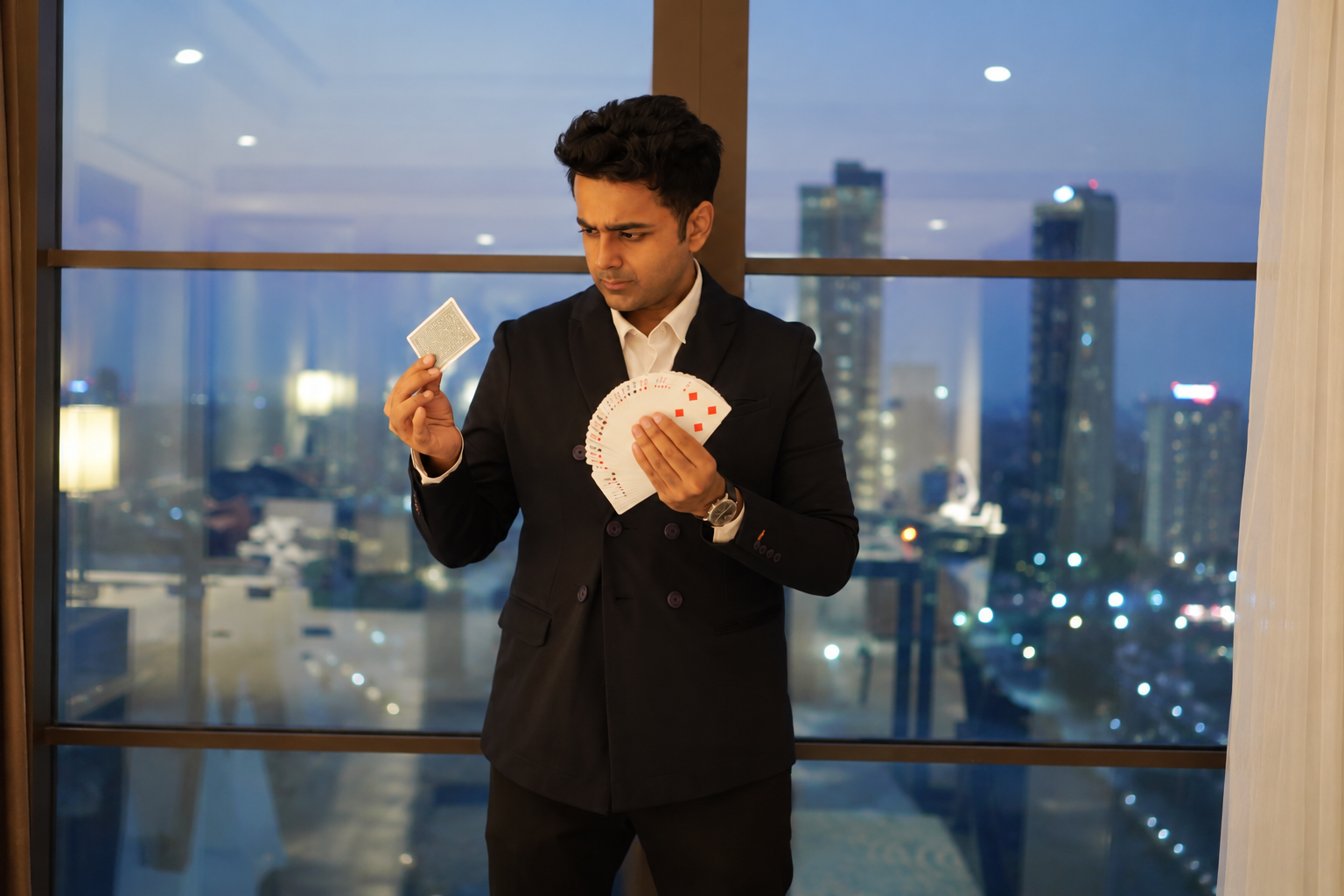

When Chirag Jethwaney first discovered magic, he wanted to become like the professional magicians he admired – Joshua Jay, David Blaine, Lance Burton and others.
More than a decade and 1,700 performances later, that ambition has almost completely reversed.
“The more I learned about the craft,” he says, “the more I realised I wanted to become more like myself.”
That evolution – from learning other people’s secrets to developing a language of his own – may be the most interesting story behind Chirag’s career.
Today, his work has taken him across countries, onto major stages and into private rooms with some of India’s most recognisable personalities. He has represented India at FISM in Germany, delivered a TEDx talk and worked with global brands.
But before any of that, there was a book.
Curiosity Before Career
Chirag’s introduction to magic arrived in 2010 through his uncle, who exports magic tricks, puzzles and gags around the world. One day, his uncle performed an effect from a magic book for him.
“My jaw was on the floor,” Chirag remembers.
He borrowed the book with a promise never to reveal its secrets.
What began as curiosity grew into an obsession with sleight of hand, illusion, psychology and mentalism. At first, progress meant learning more methods and becoming more technically capable.
Eventually, another question emerged: Why would anyone care about these effects?
“One of the great privileges of doing what I do is getting to witness people – to see someone genuinely emote and react to something you’ve created,” Chirag says. “There’s an immediate feedback loop between performer and audience that I find incredibly rewarding.”
The secret behind the trick may have drawn him into magic. People gave him a reason to stay.
Learning to Pay Attention
Spend enough time performing and technique becomes only part of the equation.
Chirag began noticing what he calls the “finer brushstrokes” – the nuances and small decisions audiences may never consciously register.
He also began paying greater attention to the people themselves. Some of his favourite conversations have been with complete strangers, and that curiosity influences the way he constructs his magic.
He has developed an uncanny ability to enter the world of a participant, understand what matters to them and make the experience mean something personally.
“The method may belong to mentalism or the art of magic,” he says, “but the experience should feel like it belongs to the person.”
“I don’t believe the same show belongs everywhere,” he adds. A theatre, corporate room, intimate celebration and luxury event each have their own language.
Learning that language requires something considerably less mysterious than mind – reading.
It requires paying attention.
What Makes a Performance Big?
Career milestones followed.
Chirag has performed for organisations and brands including Google, BMW, Lamborghini, Porsche, Cartier, Gucci, Louis Vuitton, Chanel, EY and KPMG. His audiences have included Hrithik Roshan, Mukesh Ambani and family, Sudha Murty, Narayana Murthy, Kartik Aaryan, Dilip Shanghvi, Madhuri Dixit, Shahid and Mira Kapoor, Vicky Kaushal and Sara Ali Khan.
And yet one of the performances that changed his perspective most profoundly had an audience of two.
A couple who loved magic invited him to perform for their anniversary. There was no large stage or enormous crowd – just two people sitting a few feet away.
It forced him to reconsider the relationship between scale and significance. A bigger audience does not automatically create a bigger experience.
That idea has followed him elsewhere. Performing at St. Jude’s Child Care Centre remains deeply meaningful to him, and during the pandemic he used the majority of his performances at the time to help raise funds for an animal – welfare organisation he supports.
“I think art becomes even more interesting when you realise it can be useful,” he says.
Becoming More Like Yourself
There is a strange progression in learning almost any craft.
At first, imitation is useful. You study the people you admire and understand the rules that made their work successful.
Eventually, however, the same imitation that helped you learn can begin to limit you.
Chirag’s evolution has involved gradually asking a different question.
Not How would another professional do this?
But How would I?
“You can tell a story through a deck of cards. You can tell one by reading somebody’s mind. You can do it with a fragrance, a borrowed bill or even their phone.”
That freedom has encouraged him to explore unconventional forms, from magic for radio to thinking about how impossible experiences can be created for visually impaired audiences.
If an audience cannot see the impossible happen, can you still make them feel it?
The Next Version
Today, Chirag is developing an intimate experience designed to place impossible events within inches of an audience.
He is also thinking increasingly cinematically.
“I’ve always thought of magic as fiction in motion,” he says.
He imagines richer environments and moments resembling practical special effects from a film – except they unfold live in the same room as the audience.
“I think some of the real magic in life is outdoing your own expectations of where you thought you’d be – while finding contentment in where you already are.”
Perhaps that is what the making of Chirag Jethwaney has really been about.
He began by learning how other people created impossible things.
Then he learned how to create them himself.
Now the challenge is more personal:
discovering what only he would create.