

Early one morning, sitting on a three hundred acre farm in Maryland while writing the final chapters of my book, I watched the sun rise over rows of soil that had been worked for generations. From a distance, everything looked whole. Orderly fields. Grazing livestock. Tall silos rising like monuments against the sky. Everything appeared productive.
But as the light climbed higher, the illusion began to thin.
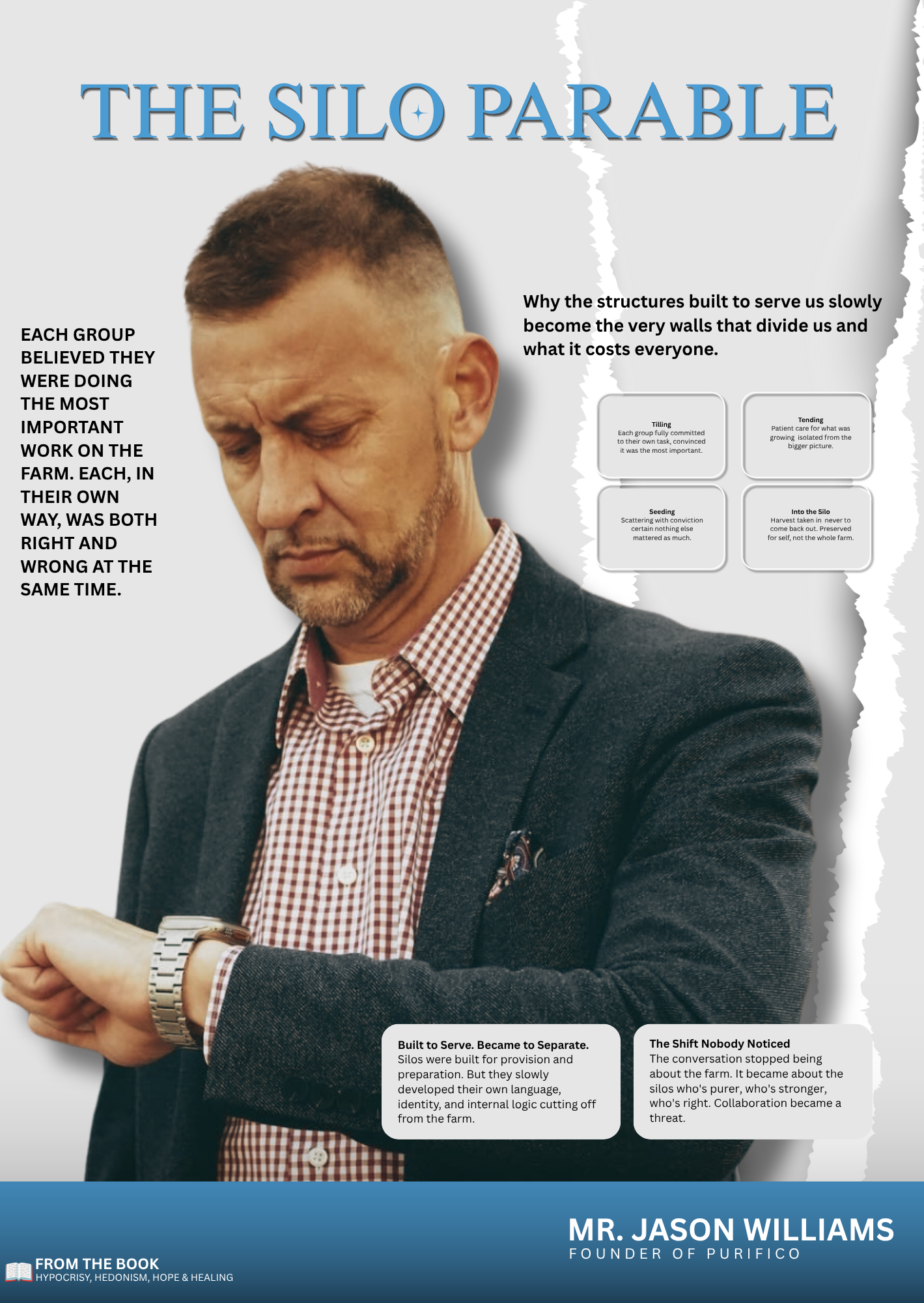
Each field had its own workers, each fully committed to their individual task. In one corner, the ground was being tilled with precision. Not far off, another group scattered seed, convinced that nothing mattered more than what went into the ground. Across the way, a crew tended young growth with patience. Beyond them, a harvest team celebrated loudly, gathering what had already come to life and carrying it straight into their silo, never to come back out. They had decided, without quite deciding, to preserve what they had for themselves rather than for the farm as a whole.
Each group believed they were doing the most important work on the farm. Each, in their own way, was both right and wrong at the same time.
And towering above it all stood the silos.
What the Silos Were Actually For
The silos were massive, immovable structures filled with grain collected from seasons past. They were impressive. They represented provision, preparation, and the hard-won fruit of real labor. But somewhere along the way, something shifted. The silos, which had been built to serve the fields, began to take on identities of their own. Workers gathered around them, not just to store grain, but to belong. Each silo developed its own language, its own internal logic, its own way of understanding the farm. People inside spoke proudly of their silo’s strength and purity, while quietly criticizing the silos that, in their view, had compromised or misunderstood the process.
Slowly, almost without anyone noticing, the conversation stopped being about the farm. It became about the silos.
When workers stepped outside their own structure, they rarely came to collaborate. More often, they came to compare. They pointed at the differences between silos, sometimes with curiosity, more often with quiet pride. Invitations to work together became rare, because why would you risk diluting what made your silo distinct?
Meanwhile, the fields waited. Fertile ground, the kind found in overlooked communities and forgotten places, sat neglected in favor of the glamor surrounding the largest, most visible silos. Some ground was tilled again and again but never planted. Other ground was seeded but never watered. In certain places, crops grew and sat unharvested, bending under their own weight, simply because the people who could have gathered them were too occupied defending the silo they belonged to. Though the silos themselves were full, the flow of grain across the farm had slowed to a trickle. What once moved freely was now being held, protected, and, without much intention behind it, restricted.
The farm still functioned. It no longer flourished.
This Was Never the Design
I did not write this parable as an abstract thought experiment. I wrote it because it is the most accurate picture I have found for something I have watched happen across religion, business, and personal identity for nearly fifty years of living.
The farm was always meant to be a place of interdependence, where every role, every field, and every expression contributed to something larger than itself. The silos were never meant to be the source of life on that farm. They were meant to be stewards of it. The fields were never meant to compete with one another. They were meant to complement one another. The workers were never meant to define themselves by what made them different from the field beside them, but by the harvest they were called to produce together, because the true measure of a farm was never what it stored. It was what it produced for the sake of others.
I think about this every time I watch a church split over a doctrinal disagreement instead of staying focused on the people it was built to serve. I think about it when I watch businesses guard information and territory instead of collaborating toward something larger than any single brand. I think about it when I watch individuals build entire identities around being right, being different, or being part of the correct group, rather than around the substance of what they actually produce in the world.
Silos are not, in themselves, the problem. Structure is necessary. Distinction has its place. The problem begins the moment storage becomes identity, and preservation replaces participation. That is the exact moment the very structures designed to sustain the harvest begin to starve the field they were built to feed.
Why This Belongs in a Book About Hypocrisy, Hedonism, Hope, and Healing
I open Hypocrisy, Hedonism, Hope & Healing with this parable because it sets the frame for everything that follows. The book is not a takedown of any single institution. It is an honest account of what happens when a person, or a community, or an entire belief system mistakes the container for the substance. I have lived inside more than a few silos in my life. I have also lived in the space between them, belonging fully to none. That position taught me to see something most people inside a silo cannot see from where they stand: the silo was never supposed to be the point. The harvest was.
If you have ever felt the quiet exhaustion of defending a structure rather than living out what that structure was originally built to protect, this is the chapter of the book I would point you toward first. It does not ask you to abandon your community, your faith, or your work. It asks
a more honest question. Has the structure you are standing inside become more important to you than the purpose it was built to serve?
That question, once you actually sit with it, tends to change the way you see everything else.
