

It is a relaxing Sunday. You reach for your smart glasses. You put them on. The EEG sensors embedded in the frame read your current state of mind and, in response, generate a short film; synthesised in that moment, adapted to your mood, your preferences, your cognitive state. And then, just as the film begins, it starts adapting to what you are about to think next.
Not what you are thinking now. What you will be thinking in the next few seconds.
That is not a scene from a science fiction screenplay. Every technology required to build it exists today. And a research paper published in December 2024 has moved the most speculative element of that vision; predicting future brain states; from the realm of theory into the realm of demonstrated, measured, reproducible science.
We have spent years asking whether machines can read our minds. The more precise question has quietly become: can they read our minds before we do?
The Paper That Changes the Question
Published in December 2024 and presented at MICCAI; one of the world’s leading conferences in medical image computing; the paper is titled “Predicting Human Brain States with Transformer.” The researchers, from the University of Sydney and collaborating institutions, set out to ask a question that most neuroscientists would have considered presumptuous even a few years ago: not can we classify what a brain is currently doing, but can we predict what it will be doing next?
The answer, with a precision that demands attention, is yes.
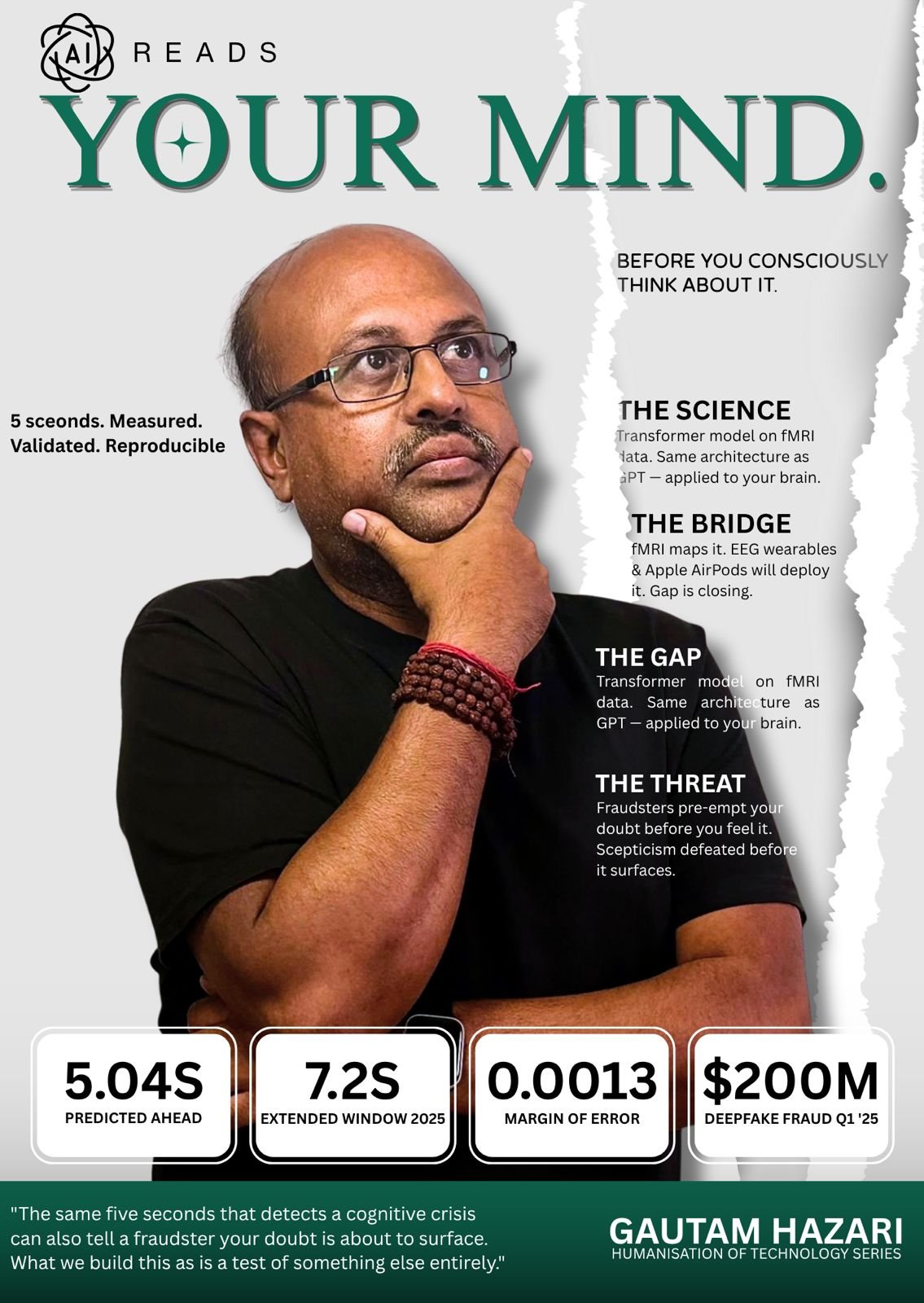
Using resting-state fMRI data from the Human Connectome Project; one of the largest and highest-quality datasets of human brain activity ever assembled; the team trained a transformer model using the same self-attention architecture that underpins modern language models and generative AI. The model was given 21.6 seconds of observed brain state data. From that, it predicted the brain states that would follow with a mean squared error of 0.0013; and a prediction horizon of 5.04 seconds.
Five seconds of future thought. Measured. Validated. Reproducible.
To appreciate what that means, consider what the brain is doing during those five seconds. Attention is shifting. Associations are forming. The precursors to decisions are assembling themselves below the threshold of conscious awareness. The researchers were not predicting noise. The predicted brain states, when analysed, preserved the architecture of functional connectivity; the relationships between brain regions that define how a particular mind organises itself. The model had not just predicted a signal. It had predicted something structurally faithful to the individual brain it was observing.
And in June 2025, the same research group published a follow-up. Using a Swin Transformer (Shifted Window Transformer) at voxel level; a higher resolution approach; they extended the prediction window to 7.2 seconds from 23.04 seconds of prior observation. The science is not standing still.
A Brief Detour Into the Biology
fMRI works by detecting changes in blood oxygenation across different regions of the brain. When neurons fire, they consume oxygen. Blood flow responds. The ratio of oxyhaemoglobin to deoxyhaemoglobin shifts, and this shift; known as the BOLD signal, for Blood Oxygen Level Dependent contrast; is what the scanner reads. Different cognitive states, different emotional registers, different modes of attention produce different BOLD signatures. The fMRI image is, in a precise sense, a spatial map of what the brain is doing at any given moment.
What the 2024 paper demonstrated is that these maps are not random. They have temporal structure. The brain state at one moment predicts, with meaningful accuracy, the brain state shortly after. And a transformer model; the same architecture that learns to predict the next word in a sentence, the next note in a piece of music; can learn that structure and extrapolate it forward.
The brain, at the level of its measurable dynamics, is more predictable than we believed. That finding sits uncomfortably alongside some of our most cherished assumptions about human agency. And it connects directly to one of the oldest and most contested questions in philosophy.
What Happens to Free Will?
The question of free will has been debated since antiquity. In neuroscience, it became acute in 1983 when Benjamin Libet’s experiments appeared to show that the brain’s readiness potential; a measurable electrical precursor to voluntary movement; began several hundred milliseconds before people reported consciously deciding to move. The interpretation was controversial then. It remains contested now.
But the research being published in 2024 and 2025 is a different kind of challenge. It is not saying that your decisions are preceded by unconscious neural activity; that has been argued for decades. It is saying that the broad structure of your cognitive states several seconds from now can be predicted by a machine, from data about your cognitive states right now. It is saying that the trajectory of thought has a momentum that is, at least partially, machine-readable.
A paper published in Frontiers in Artificial Intelligence in early 2026 framed this tension with precision. It argued that free will, if it is to remain a meaningful concept in the age of predictive AI, must be understood not as unpredictability in the statistical sense, but as what the authors called structured unpredictability; choices that deviate from causal probability distributions in ways that carry cultural, ethical, and creative meaning. In other words: we may be somewhat predictable as neural systems. We are not reducible to that predictability as human beings.
That distinction matters. But it will be cold comfort if the predictability is exploited before the philosophy catches up.
The research is not saying your choices are predetermined. It is saying your cognitive trajectory has a momentum. And that momentum is now machine-readable.
From the Internet of Thoughts to the Internet of Future Thoughts
I wrote previously about what I called the “Internet of Thoughts” (IoTh); the emerging architecture in which brain signals, read by sensors embedded in everyday wearables, are connected to networks, machine learning models, and digital services. Apple’s patent for EEG-sensing AirPods. The Human Connectome Project data. The accelerating miniaturisation of neural sensing technology. The infrastructure of the IoTh is being assembled, piece by piece, in research labs and patent filings and product roadmaps.
This new research adds a temporal dimension to that architecture. Not just the Internet of Thoughts, but evolving into the “Internet of Future Thoughts”. A network in which what you are about to think; before you think it; becomes a signal that can be read, processed, and acted upon.
The positive applications are immediate and genuinely important. Mental health diagnosis has long been hampered by its dependence on self-report; patients describing their own internal states in language that is imprecise, retrospective, and shaped by stigma and fear. A system that can predict the trajectory of cognitive states could identify the onset of a depressive episode before the person experiencing it has consciously registered the change. It could detect the early neural signatures of conditions like schizophrenia or bipolar disorder at a stage where intervention is most effective. It could help clinicians track the progress of treatment with an objectivity that no questionnaire can provide.
Researchers working in brain-computer interfaces for paralysis are already demonstrating what becomes possible when the brain’s intentions can be read ahead of conscious execution. Synchron’s implantable device enabled an ALS (ALS patient ) patient to operate his smart home through direct neural signals. Neuralink has demonstrated the ability to decode intended movement from neural activity before the movement occurs. The medical case for this technology is real and it is urgent.
But the same capability that can predict a depressive episode can predict a purchasing decision. The same capability that can detect the onset of anxiety can detect the moment of maximum susceptibility to persuasion. And the same infrastructure that delivers personalised mental health support can deliver personalised manipulation.
The Threat That Is Not Yet Named
We already know what happens when AI meets human psychology in adversarial contexts. Deepfake fraud cost consumers and businesses over two hundred million dollars in the first quarter of 2025 alone. Voice cloning technology, accessible with seconds of source audio, has enabled criminals to impersonate executives, parents, children; anyone whose voice has appeared in a public recording. Deepfake video calls have convinced employees to authorise fraudulent wire transfers of millions of dollars. One in ten people now reports receiving a message from a voice clone. Of those who engaged with it, seventy-seven percent lost money.
The current attacks exploit our trust in the present moment. We hear a voice we recognise. We see a face we know. We act, because everything we can perceive tells us we should.
Now layer onto that the capability to predict cognitive states five seconds into the future. A fraudster who knows not only what they are showing you right now, but what your brain will be processing next; what moment of hesitation is about to surface, what question is about to form, what doubt is about to crystallise; has a tool for manipulation that operates below the threshold of conscious defence. The social engineering of the future will not need to overcome your scepticism. It will anticipate it and act before it arrives.
This is not a theoretical extrapolation. It is the direct consequence of combining two trends that are both already in motion: the democratisation of neural sensing technology, and the demonstrated ability of transformer models to predict brain state trajectories. Neither development, alone, creates the threat. Together, they define it.
The Bridge Technology Already Exists
One important clarification: fMRI requires a scanner the size of a room and requires the subject to remain still inside it. This is not a wearable. It is not going to appear in smart glasses in the near future.
But the prediction models trained on fMRI data do not need fMRI to be deployed. They establish a map of how brain states relate to each other across time. That map can then be applied to data from other sensing modalities; EEG, fNIRS (Functional Near-Infrared Spectroscopy), and similar technologies that are already moving into consumer form factors.
fNIRS measures the same oxyhaemoglobin changes that fMRI detects, using light rather than magnetic fields. It is non-invasive, portable, and increasingly integrated into lightweight wearable systems. Research published in 2025 from Florida International University and North Carolina State University demonstrated a wearable fNIRS system capable of tracking cognitive fatigue in real time, with results that aligned closely with fMRI benchmarks. Brain wearables are already making traditional EEG laboratory settings obsolete, with consumer devices now monitoring sleep stages, attention levels, and emotional states outside any clinical environment.
The gap between the research setting and the consumer product is closing. It always does.
fMRI established the map. Consumer wearables will navigate by it. The question is who holds the compass.
The Governance Gap, Again
We have been here before. Every time a new layer of the internet has arrived, the governance conversation has come late. The original web arrived without an identity layer. The Internet of Things arrived without a security layer. In both cases, the harms that followed were predictable, predicted, and still largely unremedied.
The Internet of Future Thoughts is arriving with neither an identity layer nor a security layer nor a consent framework. The MIND Act, introduced in the United States Senate in September 2025, directed the FTC to study how neural data should be governed. As the technology for predicting future brain states is already being published, validated, and extended, the legislative response is to commission a study.
Several US states have enacted laws classifying neural data as a sensitive category; Colorado, California, Montana, Connecticut. These are important steps. They are not remotely proportionate to the speed of the development they are attempting to govern.
And the specific threat posed by predictive neural data; not just reading what you think, but anticipating what you will think; is not yet named in any regulatory framework anywhere in the world. The conversation about neural privacy, where it exists at all, addresses the data of the present moment. Nobody has yet built the governance language for the data of the next five seconds.
What Humanisation Demands Here
Humanisation is not a sentiment. It is a design requirement. It means asking, before the architecture is built and certainly before it is deployed, what happens to the human being at the centre of this system when it works as intended, when it fails, and when it is deliberately turned against them.
For the Internet of Future Thoughts, humanisation demands something that no previous iteration of the internet has yet achieved: proactive governance. Not frameworks that arrive after the harm. Not regulation that catches up to a technology already embedded in a hundred million devices. Governance that is part of the design, built into the standards, required before deployment, not apologised for after.
It demands that the distinction between observation and prediction be treated as a fundamental ethical line. Reading a current brain state, with consent, for health or accessibility purposes is one kind of system. Predicting future brain states and acting on those predictions; for commercial, political, or adversarial purposes; is a categorically different kind of system. Those two things must not be allowed to blur together under the general heading of neurotechnology.
And it demands that the identity question be answered before the capability is deployed at scale. The internet was built without a way to know who you are talking to. The Internet of Things was built without a way to know whether the device you are connecting to can be trusted. We cannot build the Internet of Future Thoughts without a way to know who has access to your predicted cognitive states, under what authority, with what limits, and with what recourse when those limits are violated.
The same identity infrastructure that protects your login today must evolve to protect something far more intimate: the thoughts you have not had yet.
The Five Seconds That Matter
Five seconds is a short window. It is enough time to skip a song before you consciously decide to skip it. It is enough time to serve an advertisement calibrated to a mood you are about to enter. It is enough time for a fraudster to know that your doubt is about to surface and to pre-empt it with exactly the right word.
It is also enough time for a clinician to detect that a patient is moving toward a cognitive crisis. Enough time for a driver assistance system to identify that attention is failing. Enough time for a care system looking after someone with dementia to notice that distress is building before it becomes distress.
The same five seconds. The same technology. The same prediction. What it becomes depends entirely on who built it, for whom, with what constraints, under what governance, and with what answer to the question that all technology must eventually face: is this worthy of human trust?
The Internet of Future Thoughts is not coming. It is already being assembled, in research papers and patent filings and product roadmaps, one piece at a time. The question is not whether we will build it. The question is whether we will choose to build it as if the human beings inside it matter.
Because five seconds of predicted thought is a remarkable achievement of science.
What we do with it is a test of something else entirely.
