
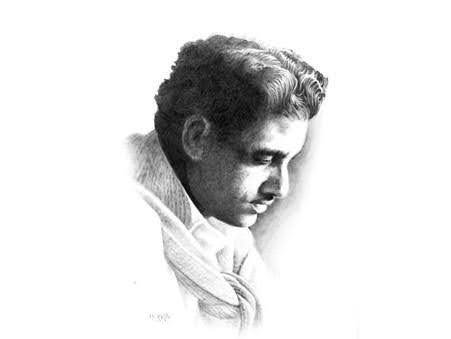

Some books are conceived as projects. Others emerge slowly, almost imperceptibly, from a writer’s inner life. Harbans Bhalla’s Peelay Pattar belonged to the second kind. It did not begin as a ten-volume literary monument, nor as a work intended to invite comparisons with the great epics of world literature. It began as a deeply personal act of writing, shaped by solitude, discipline, memory and an extraordinary commitment to the written word.
The origins of Peelay Pattar can be traced to around 1977–78, a period when Harbans Bhalla was thinking seriously about the kind of work he wished to leave behind. His exposure to the creative world, including encounters connected with the Bombay film industry, had shown him both the attraction and transience of popular success. He wanted to create something more enduring, something that could not be reduced to a passing moment. That desire gradually took the form of a sustained poetic undertaking.
Around the same period, he returned to Baroda and was posted in connection with government accounts work at the Ukai Dam project on the Tapi River. His stay at the Chamari Guest House, situated on a hillock near the dam, became an important chapter in the making of Peelay Pattar. The setting was quiet and almost meditative. The vastness of the water, the open sky, the silence of the evenings and the distance from urban distraction provided the kind of solitude that serious writing often demands.
It was there that the work began to grow. A few verses became many. A few pages became notebooks. What may initially have appeared to be a sequence of poetic thoughts slowly developed into a vast literary structure. The environment at Ukai gave Bhalla the space to listen to his own thoughts, but the real force behind the work was his discipline. He was not writing occasionally, when inspiration happened to strike. Writing became part of his daily rhythm.
Even after he returned to Baroda more permanently, the habit continued. Family recollections describe his pre-dawn routine with remarkable clarity. He would often wake during the Brahma Muhurta, when the household was still asleep, and begin writing in the early hours of the morning. Between roughly 3:30 and 5:00 a.m., before official duties, visitors and the pressures of the day began, he would sit with paper and pen and continue the work. Those quiet hours accumulated into years, and those years accumulated into tens of thousands of verses.
This is perhaps the most important way to understand Peelay Pattar. Its scale was not the result of a single burst of creativity. It was built through repetition, patience and consistency. To write a few hundred verses may depend on inspiration. To continue towards 70,000 requires something else altogether: endurance. Over nearly fourteen years, Bhalla continued writing through transfers, professional responsibilities, family life, personal pressures and the ordinary disruptions that accompany any long human journey.
The work also reflects the range of his inner world. Peelay Pattar was not confined to a single narrative or theme. Its poetic canvas extended across love, separation, philosophy, social behaviour, morality, spirituality, satire, human relationships, memory, suffering and the everyday contradictions of life. The work grew organically because Bhalla himself was responding to life as he encountered it. He could take a simple word or expression and build an entire chain of thought around it. This unusual command over language was later noted by literary critics who studied his work and described the way ordinary words could open into wider philosophical reflection.
There was also a spiritual dimension to Bhalla’s relationship with writing. In family recollection, he often spoke of the act of creation with a kind of reverence, as though the pen itself had become an instrument through which something larger than the individual was being expressed. For him, poetry was not merely a literary exercise. It was often closer to a discipline, almost a sadhana.
The title Peelay Pattar, meaning “Yellow Leaves”, is itself evocative. A yellow leaf suggests age, change, memory and the passage of time. It carries both decline and continuity. A leaf falls, but becomes part of the earth from which life continues. In retrospect, the metaphor seems especially apt for a work that would outlive its author, survive in manuscripts for years, and eventually return to readers through publication, recording, translation and scholarship.
For the family, however, the significance of what was being created may not always have been immediately visible. Children often grow up around their parents’ habits without recognizing their historical importance. A father writing every morning can seem ordinary when it happens every day. Only later, when the handwritten pages are counted and the dimensions of the work become clear, does the extraordinary emerge from the routine.
By the late 1980s, Dr. Monish Bhalla had begun to understand the importance of preserving the manuscripts. Efforts were made to photocopy and safeguard the material at a time when there were no digital backups, cloud storage systems or easy scanning technologies. The survival of a large handwritten literary work depended on physical care: copies, files, storage and constant attention. That preservation later became crucial, particularly because Harbans Bhalla would not live to see the complete publication of his magnum opus.
By 1992, after nearly fourteen years of sustained work, Peelay Pattar was complete. The final scale was staggering: approximately 70,000 verses, later organized into ten volumes. Contemporary reports would compare its sheer magnitude with Firdausi’s Shahnameh, traditionally associated with around 60,000 verses. Yet numbers alone do not explain the achievement. What makes Peelay Pattar remarkable is the persistence behind those numbers—the hundreds of mornings, the years of handwritten pages and the refusal to abandon an undertaking whose completion could never have been guaranteed.
Harbans Bhalla passed away on 5 April 1993, a little more than a year after completing the work. He did not see the full ten-volume edition in print. That responsibility eventually passed to his son, Dr. Monish Bhalla, who would spend years preserving, preparing and publishing the manuscripts. In that sense, the making of Peelay Pattar did not end in 1992. Its creative phase ended then, but its journey from manuscript to public memory continued long afterwards.
The physical spaces associated with its creation—the Chamari Guest House at Ukai, the hill overlooking the dam, the family home in Baroda and the early-morning writing desk—therefore form part of its literary history. They remind us that major works are often born far from public attention. They are built in silence, through habits that may look ordinary to everyone except the person who keeps returning to the page.
That is perhaps the deepest lesson in the making of Peelay Pattar. Literary monuments are rarely created in one dramatic moment. More often, they are built slowly, through persistence. One morning becomes a week, one notebook becomes a shelf, one year becomes fourteen, and a private act of writing becomes part of a larger cultural legacy.
Harbans Bhalla’s achievement was not only that he wrote 70,000 verses. It was that, for fourteen years, he kept returning to the pen.
