
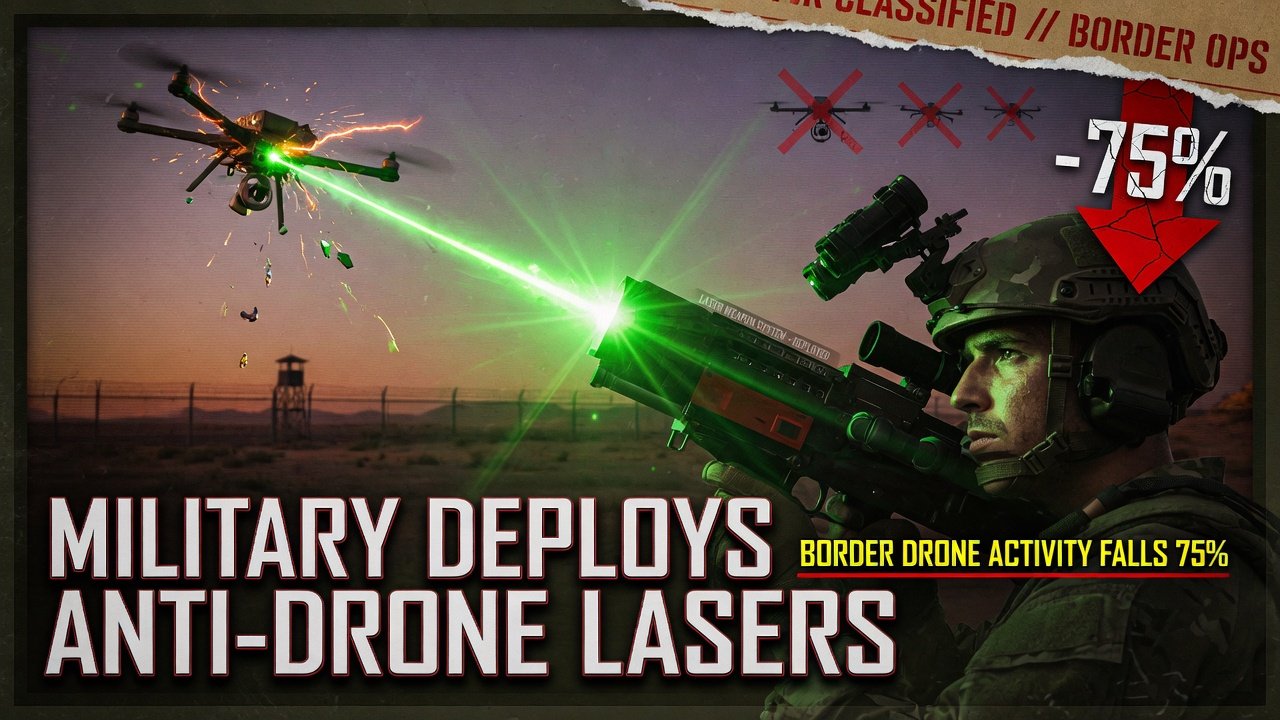

Military Deploys Anti-Drone Lasers as Border Drone Activity Falls 75%
Military Deploys Anti-Drone Lasers along the US-Mexico border has coincided with a dramatic decline in suspicious drone activity, according to US military officials. Officials told CBS News that drone activity probing the southern border in Texas’ Rio Grande Valley has fallen by roughly 75% in less than two weeks since the military began using a high-energy laser system against suspected cartel-linked drones.
The development marks a major expansion in the US military’s use of directed-energy weapons for counter-drone operations. Rather than relying only on electronic jamming, the laser gives troops the ability to physically disable or destroy drones considered an immediate threat.
US Military Begins Using High-Energy Laser Against Drones
The system used along the border is the Army Multipurpose High Energy Laser, commonly known as AMP-HEL.
The weapon’s operational debut came on August 25 and 26, when troops assigned to Joint Task Force-Southern Border used the system to engage and defeat three drones described by officials as hostile and linked to Mexican cartels.
The deployment followed months of training and testing as the military prepared to use high-energy laser technology in an environment where civilian aircraft also operate.
Drone Activity Falls by About 75%
According to military officials speaking with CBS News, the number of drones probing the Rio Grande Valley has dropped approximately 75% since the laser system was introduced.
The military has also reported that the laser destroyed 11 drones over a 10-day period following its initial deployment. Since the beginning of 2026, US forces have stopped roughly 300 drones that officials say were associated with cartel activity.
Officials, however, caution that the decline cannot necessarily be attributed entirely to the laser.
Cartels could have changed their routes, reduced operations or adjusted their tactics for other reasons. Nevertheless, the timing of the sharp decline after the laser’s operational debut has attracted significant attention from military officials.
Why Are Cartels Using Drones?
Small commercial-style drones have become an increasingly useful tool for criminal organizations operating near the border.
According to US officials, cartel-linked drones can be used to monitor US service members and Customs and Border Protection personnel. The aircraft can also provide surveillance that helps organizations support smuggling operations and identify areas where law enforcement activity is concentrated.
Because these drones are relatively small and inexpensive, stopping them presents a different challenge from defending against traditional military aircraft.
Laser Gives Troops a New Option
Before the laser was deployed for live engagements, troops commonly relied on electronic jamming.
Jamming can interfere with a drone’s communications or navigation and force it to return to its launch point. But that does not necessarily eliminate the aircraft.
Military officials say this is where the laser provides an important advantage.
If a drone is considered an immediate threat, troops can potentially disable it rather than simply disrupting its operation.
Army officials have described the ability to permanently remove a repeatedly returning drone as one of the system’s major advantages.
How the Anti-Drone Laser Works
The laser system is mounted on a vehicle and uses sensors and targeting equipment to track an aircraft.
During a demonstration observed by CBS News, soldiers tracked a small quadcopter using a camera feed and a controller. Once the drone was identified as the target, the laser was directed toward it.
The beam itself is not necessarily visible as a conventional glowing laser. Instead, concentrated energy heats and damages specific parts of the aircraft.
In the demonstration, the laser damaged the drone’s propeller and caused it to lose its ability to remain airborne.
The Cost Advantage of Laser Weapons
One of the biggest attractions of high-energy lasers is their potential cost per engagement.
According to figures cited by CBS News, an individual system may cost roughly $17.4 million to $25 million, while each laser shot can cost only a few dollars in electricity. AeroVironment has cited a cost of approximately $3 per shot.
That compares with conventional air-defense interceptors, which can cost hundreds of thousands or even millions of dollars depending on the system.
For countering large numbers of relatively inexpensive drones, the economics could therefore be significant.
FAA Coordination Becomes Critical
The deployment of powerful lasers near the southern border has also raised safety concerns.
Earlier in 2026, incidents involving the military’s laser system resulted in major concerns about its use around civilian airspace. One incident involved the accidental destruction of a US government drone, while another prompted the temporary closure of airspace around El Paso.
The FAA and Pentagon subsequently reached an agreement governing deployment of the high-energy laser system after safety testing in New Mexico. The FAA said appropriate safeguards could allow the technology to operate without creating undue risks to passenger aircraft.
Military officials now say there is regular coordination with the FAA when the system is used.
Weather Could Limit the Laser
Despite the dramatic results reported along the border, laser weapons are not considered a universal solution.
Atmospheric conditions such as rain, moisture and vapor can reduce the effectiveness of a high-energy laser by interfering with the beam’s ability to deliver concentrated energy to a target.
This means military units will likely continue using multiple counter-drone technologies rather than relying exclusively on directed-energy weapons.
Electronic warfare, surveillance systems and other air-defense tools can complement the laser when conditions are unsuitable.
The Technology Could Expand Beyond the Border
The US military’s experience in Texas could provide an important real-world test for directed-energy weapons.
The Pentagon has been investing heavily in high-energy lasers as the threat from inexpensive drones grows. Similar systems are being considered for use by different branches of the military and in different operational environments.
The border deployment is particularly significant because it places the technology in an environment where drones are relatively small, numerous and potentially difficult to distinguish from ordinary commercial aircraft.
A New Phase in Counter-Drone Warfare
The reported 75% reduction in drone activity highlights the broader strategic importance of counter-drone technology.
Drones have become increasingly accessible, allowing governments, militaries and criminal organizations to acquire surveillance capabilities at relatively low cost.
Traditional defenses can become expensive when used repeatedly against cheap unmanned aircraft. High-energy lasers offer a potential alternative because the marginal cost of firing the weapon is extremely low once the system is deployed.
However, questions surrounding weather, power requirements, targeting accuracy and civilian-airspace safety remain important.
What Happens Next?
US military officials are likely to continue monitoring drone activity in the Rio Grande Valley to determine whether the reduction remains sustained.
The key question is whether the 75% decline represents a long-term change in cartel behavior or a temporary response to the deployment of the laser.
If drone activity remains significantly lower, the border operation could strengthen the case for expanding high-energy laser deployments elsewhere.
For now, military officials view the system as another tool in a broader counter-drone strategy rather than a standalone solution.
Key Takeaway
Military Deploys Anti-Drone Lasers as US officials report a roughly 75% decline in suspicious drone activity along the Rio Grande Valley border. The AMP-HEL system has already been used to destroy multiple drones linked by officials to cartel surveillance and smuggling operations.
The technology offers a potentially inexpensive way to deal with repeated drone threats, but weather limitations and the need for strict coordination with civilian aviation remain important challenges.
FAQs
1. What happened to drone activity along the US border?
US military officials told CBS News that drone activity probing the southern border in the Rio Grande Valley has fallen by approximately 75% since the deployment of the high-energy laser system.
2. What laser system is the US military using?
The military is using the Army Multipurpose High Energy Laser, or AMP-HEL, for counter-drone operations.
3. When did the laser system first see operational use?
The system was first used operationally on August 25 and 26, 2026, when troops engaged three drones near the southern border.
4. How many drones has the laser destroyed?
Military officials told CBS News that the laser took down 11 drones over a period of about 10 days following its initial deployment.
5. Why are cartel-linked groups using drones?
US officials say the drones can be used to monitor troops and border agents and support smuggling operations.
6. How much does a laser shot cost?
CBS News reported that AeroVironment has cited a cost of approximately $3 per laser shot, although the complete weapon system costs millions of dollars.
7. Can bad weather affect laser weapons?
Yes. Rain, vapor and other atmospheric conditions can reduce the effectiveness of high-energy lasers.
8. Is the laser replacing other anti-drone systems?
No. The military continues to use tools such as electronic jamming and other counter-drone technologies alongside the laser.
9. Why does the military need FAA coordination?
Because the laser operates near civilian airspace, strict coordination is necessary to reduce the risk of aircraft being exposed to the system.
10. Does the 75% decline prove the laser caused the reduction?
Not entirely. Military officials acknowledge that other factors, including changes in cartel routes or tactics, could also have contributed to the decline.
