
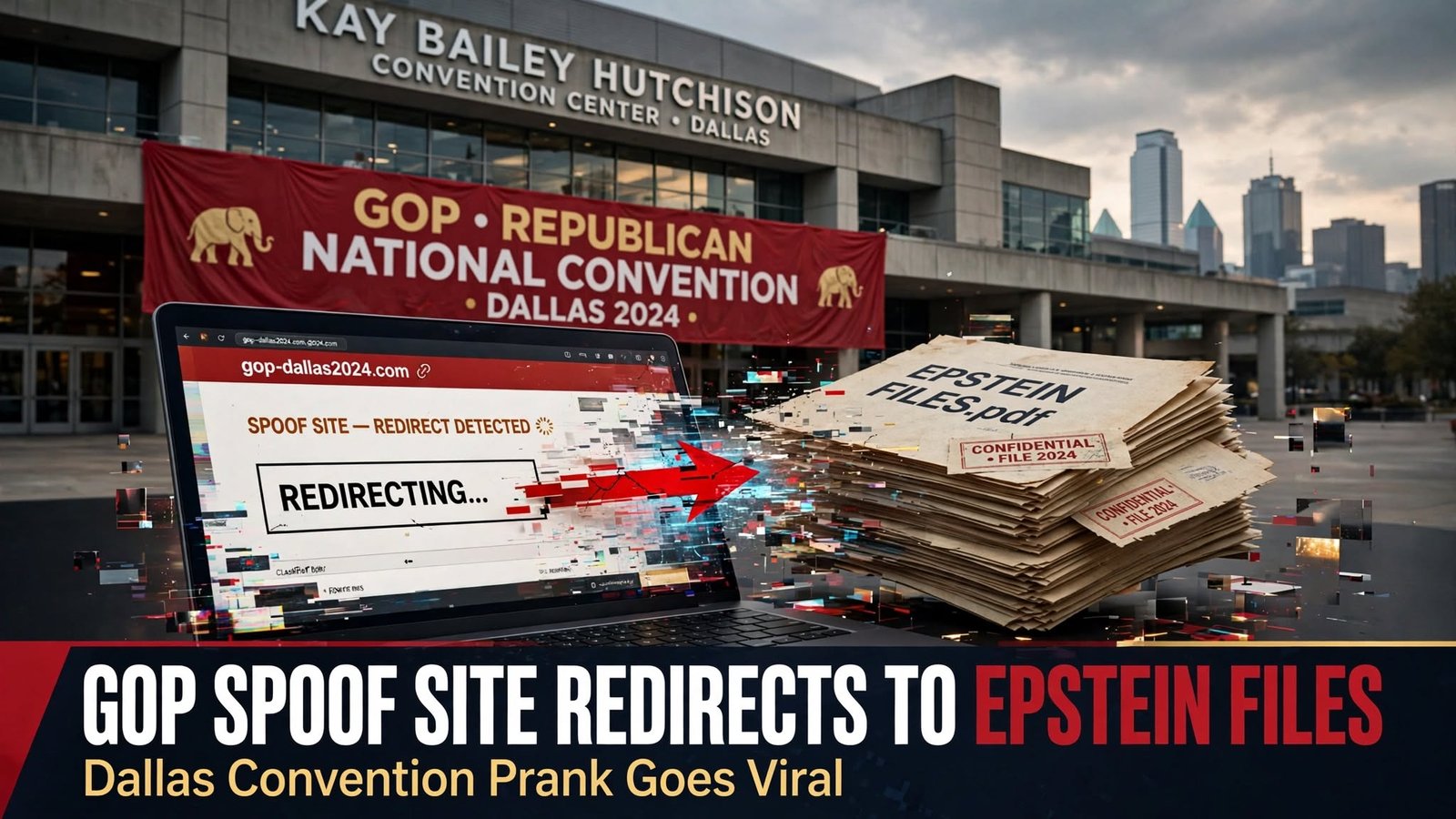

GOP Dallas Convention Spoof Website Redirects Visitors to Epstein Files
The GOP Dallas Convention has become the subject of an unusual online controversy after a spoof website resembling an official Republican convention page began appearing prominently in Google search results before redirecting visitors to the U.S. Department of Justice’s Epstein Library.
The stunt quickly attracted attention across social media, with users sharing screenshots, parody videos and jokes about the unexpected destination. The incident also triggered criticism and frustration among Republican communications teams as the spoof site gained visibility ahead of the party’s upcoming convention in Dallas.
The website, identified as gopdallas2026.com, was designed to look similar to a political convention website. However, it was not the official website of the Republican National Committee.
Spoof GOP Dallas Convention Website Gains Search Visibility
The most notable part of the incident was not simply the website itself, but how easily it appeared in Google searches related to the GOP Dallas Convention.
The spoof page was reportedly optimized or positioned in a way that allowed it to surface prominently when people searched for information about the upcoming Republican gathering.
Instead of providing convention schedules, speaker information or registration details, visitors were ultimately redirected to the U.S. Department of Justice’s online Epstein Library.
That combination of political branding, search visibility and an unexpected redirect turned the website into a viral internet story.
Website Was Not the Official Republican Convention Site
Despite the website’s appearance, the spoof page was not the official Republican National Committee convention website.
The official Republican convention website is separate from the spoof domain, meaning visitors who encountered the look-alike page were not necessarily viewing information published by the Republican Party.
This distinction is important because early social media reactions described the incident as a possible hack. However, available reporting did not establish that the official Republican website itself had been hacked or compromised.
Instead, the incident appeared to involve a separate website designed to resemble the real convention presence online.
Why the Epstein Files Became the Punchline
The redirect to the Epstein Library was the central element of the stunt.
The Epstein Library contains documents and records released by the U.S. Department of Justice relating to Jeffrey Epstein and associated investigations.
By sending visitors searching for Republican convention information to the government’s Epstein records, the spoof website created an obvious political message designed for maximum attention.
The move also gave the website an unusual combination of search-engine relevance and social-media shareability.
Rather than simply publishing a political joke, the creators used a real search query and a real government archive to make the satire more visible.
GOP Convention 2026 Set for Dallas
The incident comes just days before the Republican Party’s scheduled midterm convention in Dallas.
The GOP convention 2026 is scheduled for September 9 and 10 at the American Airlines Center in Dallas, bringing Republican officials, activists and political figures together ahead of the 2026 midterm elections.
Because the convention is already attracting significant online interest, searches for the event have provided an opportunity for political commentators, activists and satirical creators to compete for attention.
The spoof website appears to have taken advantage of that growing search interest.
How SEO Played a Role in the Viral Stunt
Search engine optimization appears to have been one of the most important components of the campaign.
A political website does not necessarily need millions of visitors to become influential online. If it appears high in search results for a trending political topic, thousands of people can encounter it organically.
The GOP Dallas Convention was already a timely search topic because of the upcoming Republican gathering.
By creating a website around that subject and making it resemble an official source, the spoof site could attract users who were simply searching for convention information.
Once users discovered the unexpected redirect, screenshots and social media posts helped amplify the story even further.
Social Media Turns the Website Into a Viral Joke
Political satire often spreads faster when it can be explained in a single image or short video.
That was the case with the GOP spoof website.
Users began sharing reactions to the website and its Epstein Library redirect, producing parody clips and commentary across social platforms.
The controversy also generated a broader discussion about how easily political websites can be imitated and how search engines can sometimes surface unofficial pages alongside legitimate sources.
For users searching for political information, the episode served as a reminder to check website domains carefully before assuming that a page is official.
GOP Communications Teams Face an Unusual Online Distraction
For Republican communications teams, the incident created another layer of online noise surrounding the upcoming convention.
Instead of conversations being focused entirely on speakers, policy discussions and the party’s midterm strategy, the spoof website became a separate viral topic.
Political campaigns and organizations routinely monitor search results because unofficial pages, parody accounts and misleading websites can influence public perception.
The incident demonstrates how a relatively simple website can generate significant attention when it connects itself to a major political event.
Was the GOP Dallas Convention Website Hacked?
There is an important distinction between a spoof website and an actual website hack.
The viral website was not established as the official Republican National Committee convention website. Reports instead described it as a look-alike or spoof website.
That means the available information does not support claiming that the official GOP convention website was hacked.
The confusion largely came from the website’s appearance and its prominence in Google search results.
For readers encountering similar incidents online, checking the exact domain name is one of the easiest ways to determine whether a website is actually affiliated with an organization.
Political Satire Meets Search Engine Manipulation
The incident highlights a growing intersection between political satire and digital marketing techniques.
Political jokes traditionally relied on memes, parody accounts and edited videos. Modern online campaigns can go a step further by building websites designed to appear in search results for highly relevant terms.
That approach can give satire a much larger audience than a normal social media post.
The GOP Dallas Convention incident shows how SEO can become part of political communication, even when the website itself is not affiliated with the organization being targeted.
Why the Incident Matters Beyond One Website
The episode raises broader questions about trust on the internet.
Search engines attempt to provide users with relevant information, but high search rankings do not automatically mean that a website is an official source.
Political events are particularly vulnerable to this type of confusion because people often search for schedules, locations, speakers and registration information shortly before an event.
A spoof website appearing alongside legitimate results can therefore attract visitors who may not immediately notice the difference.
The incident also demonstrates how quickly online satire can become a mainstream political talking point when it intersects with a controversial subject such as the Epstein files.
What Happens Next?
The attention surrounding the spoof website is likely to continue as the Republican convention approaches.
Search engines may adjust their results, the spoof domain could change its behavior, or the site could disappear entirely.
At the same time, social media users may continue creating parody content around the incident.
For political organizations, the episode offers another example of why controlling official digital channels and maintaining a strong search presence can be important during major political events.
For users, the lesson is simpler: when searching for political information, verify the domain before assuming that a website represents the organization it appears to represent.
Key Takeaway
The GOP Dallas Convention spoof website became a viral political story after appearing prominently in Google search results and redirecting visitors to the U.S. Department of Justice’s Epstein Library.
The website was not the official Republican National Committee convention site, and available reporting did not establish that the official site had been hacked.
Instead, the incident appears to have been a politically motivated spoof and SEO-driven stunt that used search visibility, satire and a controversial subject to attract attention.
With the Republican convention scheduled for September 9–10 in Dallas, the episode highlights how search engines and digital satire can increasingly shape political conversations.
FAQs
1. What is the GOP Dallas Convention?
The GOP Dallas Convention is the Republican Party’s upcoming midterm convention scheduled to take place in Dallas in September 2026.
2. What happened to the GOP Dallas Convention website?
A spoof website resembling a Republican convention website appeared prominently in Google searches and redirected visitors to the U.S. Department of Justice’s Epstein Library.
3. Was the GOP Dallas Convention website hacked?
There is no confirmed evidence that the official Republican convention website was hacked. The viral website was a separate spoof or look-alike site.
4. What is gopdallas2026.com?
gopdallas2026.com was a spoof website that appeared to resemble a website associated with the GOP Dallas Convention.
5. Where did the spoof website redirect visitors?
The website redirected visitors to the U.S. Department of Justice’s Epstein Library.
6. What are the Epstein files?
The term “Epstein files” broadly refers to documents and records relating to Jeffrey Epstein that have been released or made available through government and court records.
7. Why did the spoof website become viral?
The combination of a major political event, prominent Google search visibility and a redirect to the controversial Epstein records helped the website attract widespread attention.
8. When is the GOP convention in Dallas?
The Republican midterm convention is scheduled for September 9 and 10, 2026, in Dallas.
9. Is gopdallas2026.com the official GOP website?
No. The spoof domain was not the official Republican National Committee convention website.
10. What does this incident show about political SEO?
The incident demonstrates how search visibility can be used to amplify political satire and attract attention to unofficial websites, particularly when people are actively searching for information about a major political event.
