

In today’s professional world, expertise may establish competence, but communication determines how effectively that competence is understood and valued.
Across boardrooms, businesses and professional environments, accomplished individuals bring considerable knowledge and experience to the table. Yet having the right perspective is only part of the equation. Ideas need to be articulated with clarity, conversations require purpose and leaders must be able to connect their thinking with the people around them.
This is where communication becomes more than a professional skill. It becomes an essential part of leadership.
The ability to express a point of view with clarity, confidence and conviction shapes how people engage with ideas, respond to decisions and build trust. Particularly in defining professional moments, what matters is not simply the depth of our knowledge, but our ability to translate that knowledge into something others can understand, remember and act upon.
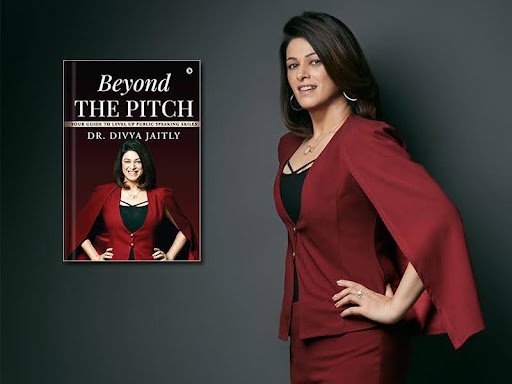
This philosophy sits at the heart of Dr. Divya Jaitly’s work as an author, entrepreneur, executive coach, leadership facilitator and three time TEDx speaker.
Drawing upon 25 years of experience across industries, Dr. Jaitly approaches public speaking as something far broader than performing on a stage. For her, communication is about finding the words, presence and confidence to contribute meaningfully when it matters.
At its core is a simple premise: expertise gives us something valuable to say. Communication gives that expertise a voice.
Communication Is More Than Public Speaking
Public speaking is traditionally associated with a stage, a microphone and an audience. Beyond The Pitch expands that definition by bringing communication into the everyday moments where professional impact is actually created.
An interview, a boardroom discussion, a client conversation, a negotiation or even a difficult exchange with a colleague can become a defining communication moment. These are situations where professionals are required not merely to speak, but to think clearly, read the room, adapt their message and connect with the people in front of them.
For Dr. Jaitly, effective communication is not about perfection or performance. It is about alignment between what we intend to convey, how we convey it and how it is ultimately received.
This thinking is captured through her practical 3Vs framework: Verbal, Vocal and Visual communication. The Verbal dimension focuses on the words and structure of the message; the Vocal on tone, pace, pitch and modulation; and the Visual on body language, expressions and presence. Together, they determine not only what an audience hears, but how a message is experienced and remembered.
The framework also reflects a larger philosophy within Beyond The Pitch: communication cannot be reduced to eloquence alone. A compelling message requires substance, self awareness and an understanding of the people receiving it.
The goal, therefore, is not simply to become a better public speaker. It is to develop the ability to communicate with intention across situations, audiences and environments, especially when the conversation matters.
Expertise Shaped by Experience
One of the defining strengths of Beyond The Pitch is that its lessons are grounded in experience rather than theory alone.
Over the years, Dr. Jaitly has coached, mentored and trained more than 10,000 individuals across industries and career stages, from students and emerging entrepreneurs to senior executives and business leaders. This exposure has offered her a unique vantage point into how people communicate, where they hesitate and what often prevents capable professionals from expressing their true potential.
A recurring insight emerged from these interactions. Professional competence does not automatically create communication confidence. Some of the most knowledgeable people in a room may still struggle to articulate an idea, command attention or communicate with the conviction their expertise deserves.
Beyond The Pitch grew, in part, from these observations. Its chapters address real challenges that surface in professional communication, from body language and voice modulation to storytelling, stage presence, humour and managing nervousness. Each is approached not as an isolated speaking technique, but as part of the larger ability to connect with an audience and communicate with impact.
The emphasis throughout is on application. Rather than prescribing a single style of speaking, the book equips readers with practical techniques they can adapt to their own personalities, professional environments and communication situations.
In that sense, Beyond The Pitch is not about teaching people how to perform. It is about helping them communicate in a way that allows their competence to be seen, heard and understood.
Finding Your Own Voice
Confident communication is not an innate quality reserved for a select few. It is a capability that can be consciously developed and strengthened over time.
The book itself evolved over a journey of nearly two years. Dr. Jaitly wrote and refined its chapters alongside leadership workshops, executive coaching conversations and business engagements. These experiences continually brought her back to one question: What will help the reader move from knowing to doing?
That philosophy also shapes her approach to confidence. Rather than encouraging professionals to emulate accomplished speakers or conform to a prescribed style, she advocates discovering and strengthening one’s own voice. This begins with recognising individual strengths, becoming aware of areas that need development and learning to communicate in a manner that feels both effective and authentic.
For Dr. Jaitly, comparison can often become an unnecessary barrier. The objective is not to sound like the most impressive person in the room, but to become increasingly comfortable and credible in expressing what one knows, believes and can contribute.
Lasting confidence, therefore, is rarely the starting point. It is the outcome of preparation, practice, self awareness and the willingness to keep showing up. With every conversation, presentation and opportunity to speak, confidence grows from something we seek into something we build.
From the Studio to the Boardroom
Dr. Divya Jaitly’s perspective on communication has been shaped by a career that has unfolded across remarkably different professional environments, spanning media, entrepreneurship, corporate communication, leadership development and governance.
Her early years in television placed her in an arena where clarity, presence and composure were tested in real time. She went on to become the only Indian woman to present the Olympic Games live on national television twice, at Athens 2004 and Rio 2016, an experience that demanded the ability to think on her feet, engage diverse audiences and communicate with confidence under pressure.
Over the years, that experience evolved beyond the studio. As an entrepreneur, executive coach, leadership facilitator and board advisor, she has worked across organisations and leadership levels, gaining a close understanding of how communication changes when the stakes move from engaging an audience to influencing people, navigating complexity and shaping decisions.
It is this intersection of media experience, business leadership and executive development that informs her perspective today. Her approach combines the discipline of professional communication with an understanding of the realities leaders face, where how an idea is articulated can often determine how effectively it travels from thought to action.
When Expertise Becomes Influence
Ultimately, the relevance of Beyond The Pitch lies in a reality that extends far beyond public speaking. In today’s professional world, ideas do not create impact simply because they are good. They create impact when they can be understood, trusted and carried forward by others.
This is particularly significant as leadership becomes less dependent on hierarchy and increasingly shaped by the ability to influence across teams, stakeholders and organisations. Framing an idea, telling a compelling story, navigating a difficult conversation, engaging an audience or demonstrating presence in a defining moment are no longer peripheral skills. They are part of how professionals build trust and translate expertise into action.
The book therefore speaks not only to those who want to become better speakers, but to professionals who want their ideas to travel further, their perspectives to carry greater weight and their presence to reflect the value they bring.
Perhaps that is the larger message behind Dr. Jaitly’s work. Communication is not a performance reserved for the spotlight. It is a capability we carry into every room, every relationship and every opportunity to influence.
A powerful idea may open a door. The ability to communicate it well determines how far it travels.
