
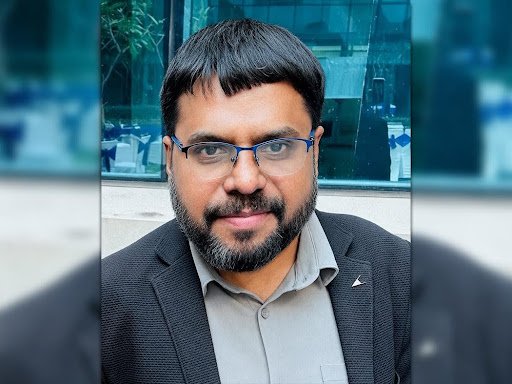

Space research demands precision. Every image, coordinate, and observation must be verified before drawing conclusions. Former ISRO scientist Jijith Nadumuri Ravi spent years working in this environment, contributing to India’s Chandrayaan-1 mission and earning appreciation from former President Dr. A.P.J. Abdul Kalam.
After his career in space research, Ravi turned his attention to a very different frontier—India’s ancient past.
Instead of studying the Moon, he began examining the Rigveda, the Ramayana, and the Mahabharata through the same analytical mindset that shaped his scientific career. His question was simple: Can modern scientific methods help us better understand India’s oldest texts?
Reading Ancient Texts Like Scientific Data
The Rigveda, Ramayana, and Mahabharata have long been examined through history, archaeology, and Sanskrit scholarship. Ravi approached them from another perspective. Rather than viewing them solely as literary or religious works, he treated them as sources of geographical and chronological information.
This idea became the foundation of his Geo-Chronology Series, comprising Rivers of Rigveda, Geography of Ramayana, and Geography of Mahabharata (Volumes I and II).
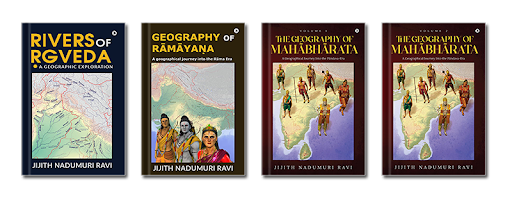
This year he is coming with the next book – From Parikshit to Present – that focus on the post Kurukshetra War period upto 21st century CE and the final book – Dharmic Grand Narrative – exploring the future of Sanātana Dharma beyond 21st century CE.
Twenty-Five Years, 110,000 Verses, One Research Mission
Over twenty-five years, Ravi studied more than 110,000 Sanskrit verses, comparing textual references with satellite imagery, historical maps, topographical records, and modern mapping tools.
He cross-verified descriptions of rivers, forests, kingdoms, and travel routes across multiple texts, creating hundreds of maps that visualize ancient landscapes and the movement of civilizations. The project also led to more than 100 research findings that contribute to discussions on the geography and chronology of ancient India.
His approach reflects the discipline of scientific research, where evidence is examined from multiple sources before patterns and conclusions are established.
Connecting India’s Forgotten Timeline
One of the main objectives of Ravi’s research is to bridge a long-standing gap in Indian history.
Conventional historical narratives often begin with dynasties such as the Mauryas, Sungas, and Guptas, while the rulers and events described in the Vedas and epics are frequently placed outside recorded history. Ravi’s work explores whether these traditions can be viewed as parts of a continuous civilizational timeline.
According to his research, geography plays an important role in this effort. Rivers, mountain ranges, and regional landscapes often preserve historical continuity, making them valuable references for reconstructing the past.
Bringing Scientific Thinking to Ancient India
Ravi’s work highlights how scientific methods can complement historical research. The same principles used in scientific investigation—careful observation, data analysis, and systematic verification—can also be applied to the study of ancient civilizations.
As technology continues to reshape historical research, combining geography, mapping, and textual analysis is opening new ways to examine India’s civilizational heritage.
From helping map the Moon to studying the landscapes described in India’s ancient epics, Jijith Nadumuri Ravi’s work reflects how scientific thinking can cross disciplines, offering a fresh perspective on one of the world’s oldest civilizations.
