
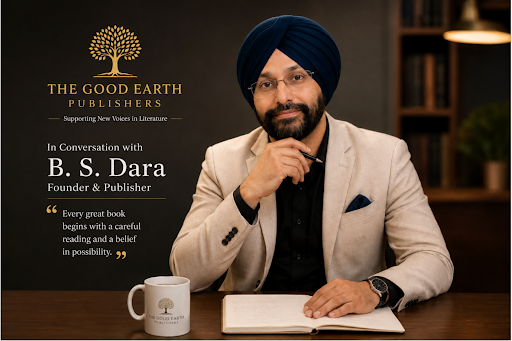

In an era where anyone can publish a book, the real challenge is helping meaningful stories rise above the noise. At the heart of that mission is B. S. Dara, Founder and Publisher of The Good Earth Publishers, an independent literary publisher and author-services platform dedicated to empowering writers through thoughtful editorial guidance, self-publishing support, structural writing resources, and industry insights.
Driven by the belief that every compelling story deserves the opportunity to be discovered, The Good Earth Publishers has taken that commitment a step further by launching its Complimentary Author Visibility Programme to help writers to connect with readers in an increasingly competitive literary landscape.
In this exclusive conversation, B. S. Dara shares the vision behind The Good Earth Publishers, towards the enduring value of authentic storytelling, and explains why meaningful editorial support can transform both a manuscript and the writer behind it.
Q1. The Good Earth Publishers is a relatively young independent publishing house. What inspired you to establish it?
S. Dara: Publishing has always meant much more to me than printing books. As an author myself, I experienced the excitement, uncertainty, and often the isolation that many writers feel when they complete a manuscript and begin looking for a publisher. I realised that many talented writers are not rejected because they lack imagination, but because they lack guidance, editorial support, or simply someone willing to invest time in understanding their work.
The Good Earth Publishers was founded with a simple belief that every manuscript deserves a fair reading, and every author deserves to be treated with respect. We wanted to build a publishing house that values editorial excellence while remaining approachable to both established and first-time writers.
Q2. How would you describe the philosophy of The Good Earth Publishers?
We believe that publishing begins long before a book reaches the printer. It begins with listening to the author. Every manuscript represents months and years of someone’s life. Whether we eventually publish a project or not, we believe that writers deserve honesty, professionalism, and meaningful engagement with their work. Our philosophy is built on three principles: editorial integrity, transparency, and long-term relationships with authors.
Q3. What kinds of books does The Good Earth Publishers publish?
Our catalogue continues to grow across a wide range of genres, including literary fiction, contemporary fiction, psychological thrillers, children’s literature, memoirs, spirituality, history, biography, self-development, and narrative non-fiction. We are less interested in chasing trends and more interested in discovering authentic voices. A good manuscript is one that has something meaningful to say and says it well. Alongside our published titles, we are also working with several promising authors whose manuscripts are currently undergoing editorial development. Supporting writers through that journey is an important part of what we do.
Q4. Many aspiring writers describe publishers as difficult to approach. Has TGEP tried to change that experience?
Absolutely. We want authors to feel that they are speaking with editors rather than simply submitting files into a system. Where appropriate, we provide preliminary editorial assessments, developmental observations, publication recommendations, sample editing, and even preliminary cover concepts. Not every manuscript reaches publication, but every promising manuscript deserves thoughtful attention. Publishing should never feel impersonal.
Q5. Your website seems to offer much more than manuscript submission. Was that intentional?
Very much so. We wanted our website to become a resource for writers rather than merely a Publisher’s website. Readers, Writers and Publishers can learn about our publishing programmes, editorial process, submission guidelines, books, authors, and the values that guide our work. We regularly introduce new initiatives that encourage writers to understand publishing more clearly and make informed decisions about their literary journeys. Our objective is to make the publishing process transparent rather than mysterious.
Q6. One initiative that has attracted attention is the Complimentary Author Visibility Programme. What inspired it?
We realised that publication is only one part of an author’s journey. Many debut writers remain invisible until their books appear, even though they often have fascinating stories, ideas, and creative experiences worth sharing. Through our Complimentary Author Visibility Programme, we invite selected authors to participate in interviews and editorial features that introduce readers to the person behind the manuscript. It is our way of encouraging emerging writers and helping them begin building a literary presence with confidence.
Q7. What qualities do you look for when evaluating a manuscript?
Originality. Authenticity. Emotional honesty. A manuscript does not need to be perfect on the first submission. That is what editing is for. What cannot be manufactured is an authentic voice. When we discover a writer with something meaningful to say, we become interested in the possibilities that manuscript holds.
Q8. Has technology changed publishing?
Technology has transformed publishing in many positive ways. Writers today have access to better tools, wider readerships, and more opportunities than ever before. At the same time, editorial judgement remains irreplaceable. Publishing is ultimately about understanding stories, people, and readers. No technology can replace thoughtful editorial discussion or the relationship between an editor and an author.
Q9. What advice would you give to aspiring writers?
Write honestly. Read widely. Accept that revision is part of writing. Do not measure your work only by immediate publication or commercial success. Every accomplished author began as an unpublished writer. Most importantly, remember that rejection is often part of the publishing journey. Sometimes it simply means that your manuscript has not yet found the right publisher or reached its strongest form.
Q10. What lies ahead for The Good Earth Publishers?
We hope to continue expanding our catalogue while remaining true to our editorial principles. Beyond publishing books, we are developing initiatives that encourage literary conversation, support emerging writers, and connect readers with new voices. We see publishing not merely as producing books but as contributing to a healthy literary culture. If authors look back years from now and say that The Good Earth Publishers gave them an opportunity, encouraged their writing, or helped them grow as storytellers, that will be one of our greatest achievements.
About B. S. Dara
S. Dara is an accomplished author and independent geopolitical analyst, he has written extensively on international security, strategic competition, and global power transitions, with more than two hundred published op-eds in leading Indian newspapers. His fiction has earned recognition beyond commercial publishing, with his books becoming part of the collection of the Qatar National Library.. Through initiatives like the Complimentary Author Visibility Programme and The Good Earth Conversations, The Good Earth Publishers aims to introduce new writers long before their books reach readers.
Connect with B. S. Dara: Readers can learn more about his books, articles, and work by visiting B. S. Dara’s official website. Information about The Good Earth Publishers, its publishing programmes, editorial resources, manuscript submissions, and author initiatives is available at The Good Earth Publishers.
