
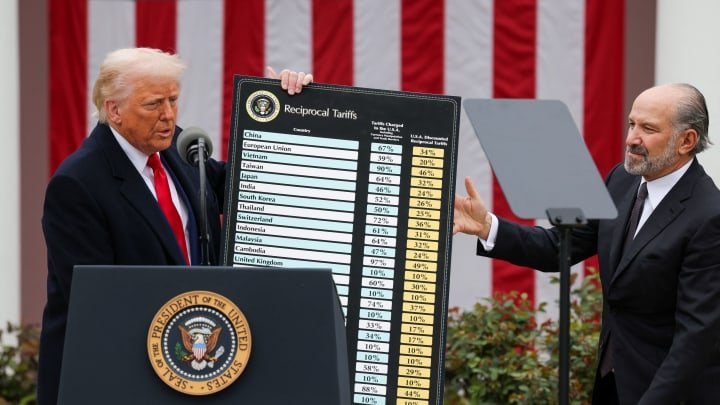

Former President Donald Trump has rolled out a sweeping set of tariffs on goods entering the United States from much of the world, reigniting debates over trade, prices, and America’s role in the global economy.
Trump argues that these import taxes are meant to revive domestic manufacturing, protect American jobs, and force trading partners to play fair. Critics, however, warn that the tariffs risk raising prices for everyday consumers, straining international relationships, and slowing global growth. Adding another layer of uncertainty, the US Supreme Court is now weighing the legality of some of these measures.
Below is a clear, human-friendly breakdown of which tariffs has Trump announced, and what’s driving them?
What Are Tariffs and How Do They Work?
Tariffs are taxes imposed on goods imported from other countries. In most cases, they are charged as a percentage of the product’s value.
For instance, if a $10 item faces a 10% tariff, an extra $1 is added, raising the cost to $11. The importing company pays this tax to the US government, but that cost rarely stops there. Businesses often pass some or all of it on to consumers, meaning higher prices on store shelves. In other cases, firms may cut back on imports altogether.
Why Trump Is Using Tariffs
Trump has long argued that tariffs serve several purposes at once. According to him, they help raise government revenue, encourage Americans to buy domestically made products, and push companies to invest more inside the US.
A central goal is shrinking the US trade deficit — the gap between what America imports and what it exports. Trump has repeatedly claimed that the US has been taken advantage of by foreign competitors, using terms like “cheaters” and “pillaged” to describe trading partners.
Beyond economics, tariffs have also been used as leverage. When targeting countries such as China, Mexico, and Canada, Trump tied trade penalties to demands that they do more to curb illegal migration and the flow of fentanyl into the US. In other instances, tariffs have been floated — then walked back — as political pressure tools, with some measures later delayed, revised, or scrapped altogether.
Trump’s Tariffs by Country
Negotiations are ongoing with several major US trading partners, especially the top three:
China:
The US and China initially threatened tariffs exceeding 100% on each other’s goods before agreeing to a truce. In late October, Trump said a trade deal would be signed “pretty soon” and canceled certain tariffs linked to fentanyl production. Exemptions on 178 Chinese products have been extended until November 2026, though reduced tariffs still apply to many non-exempt items.
Canada:
Canada faces tariffs of up to 35%, although most goods are exempt under the USMCA trade agreement. It is still affected by a 50% tariff on imported metals and a 25% duty on non-US cars. Trump has repeatedly warned of higher penalties, including a threatened 100% tariff if Canada finalizes a trade deal with China.
Mexico:
Mexican goods face 30% tariffs, along with sector-specific duties and a fentanyl-related levy. As with Canada, most products remain exempt under USMCA, and non-exempt tariffs are currently suspended during talks.
Tariffs on the Rest of the World
In April 2025, Trump announced a baseline 10% tariff on imports from nearly all other countries, with higher rates for nations labeled the “worst offenders” in trade practices. After negotiations, the following rates were confirmed:
-
50% on Indian goods (including a 25% penalty linked to trade with Russia)
-
50% on Brazilian goods
-
30% on South African goods
-
20% on Vietnamese goods
-
15% on Japanese goods
-
15% on most European Union goods
Additional measures include a 25% tariff on Iran’s trading partners and an increase in South Korean tariffs from 15% to 25%, after Trump accused Seoul of failing to meet earlier commitments.
The UK Tariff Deal Explained
The UK secured one of the lowest tariff rates so far. In June 2025, it negotiated a 10% tariff on exports to the US. The rate applies to the first 100,000 UK vehicles exported each year, roughly matching 2024 levels. Any additional cars face the standard 25% duty.
The deal also reopened beef trade between the two countries. However, hopes that the 25% tariff on UK steel would be lifted have faded, despite early optimism when Trump declared the agreement “done.”
Which Goods Are Hit the Hardest?
Some tariffs apply to specific products regardless of where they are made, including:
-
100% tariff on branded or patented drugs (unless produced in the US)
-
50% on steel and aluminum imports (excluding the UK)
-
50% on copper
-
50% on kitchen cabinets, bathroom fittings, and some furniture
-
25% on most foreign-made cars, engines, and auto parts
-
25% on heavy-duty trucks
Trump also ended the duty-free exemption for low-value imports under $800. As a result, millions of low-cost parcels — including those from retailers like Shein and Temu — are now subject to tariffs or flat fees.
Why the Supreme Court Is Involved
Many of Trump’s tariffs have been challenged in court. Some were introduced under the 1977 International Emergency Economic Powers Act, allowing the president to bypass Congress by declaring a national emergency.
In August 2025, a US appeals court ruled that most tariffs imposed under this authority were unlawful, though it allowed them to remain in effect temporarily. The case is now before the Supreme Court, with a decision expected soon. Trump has warned that striking down the tariffs could trigger chaos, particularly if businesses seek refunds.
Are US Consumers Paying More?
Yes — at least in part. Prices have risen for products such as toys, furniture, appliances, and certain foods. Inflation stood at 2.7% in December, higher than earlier in the year before most tariffs took effect.
Major retailers, including Walmart, Target, and Adidas, have acknowledged passing some of the added costs on to customers. Goods made in the US using imported components are also becoming more expensive, especially in industries like auto manufacturing, where parts often cross borders multiple times.
The Bigger Economic Impact
Trump’s tariff push initially rattled global markets, and while financial systems have steadied, uncertainty remains. The International Monetary Fund has warned that US tariffs are weighing on global growth, forecasting slower expansion through 2026 compared with pre-tariff projections.
Despite this, the US economy has shown resilience. Growth surged in late 2025, driven by strong consumer spending and rising exports, even as imports declined. While the long-term effects are still unfolding, one thing is clear: Trump’s tariffs have reshaped trade debates at home and abroad — and the final verdict, legally and economically, is still to come.
