
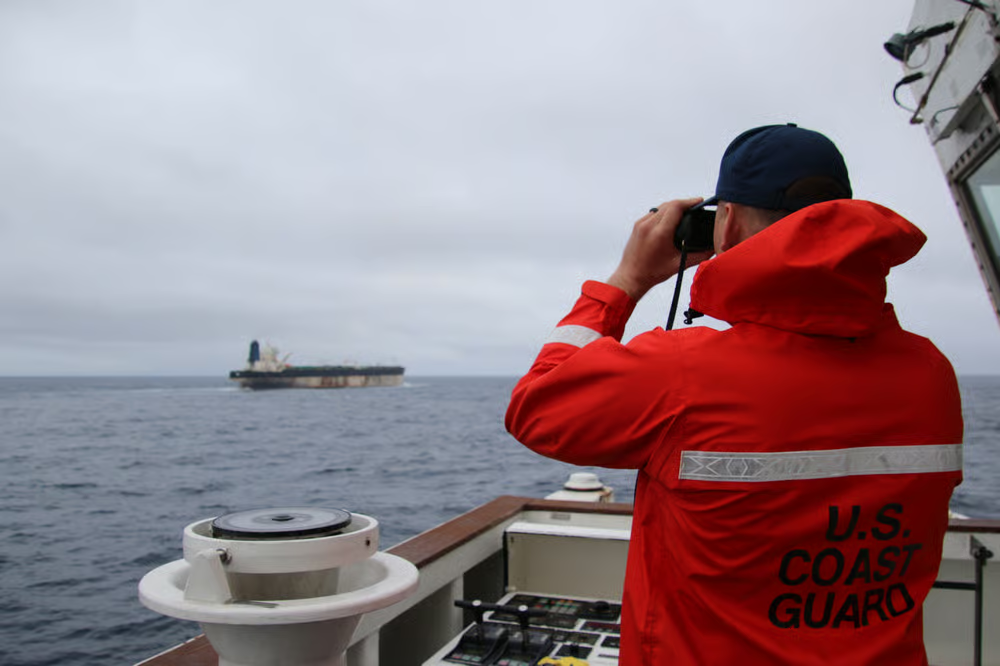

U.S. authorities have removed the captain and first officer of a Russian-flagged oil tanker from British jurisdiction, marking a dramatic escalation in an already tense international dispute. In what officials described as a coordinated operation, U.S. transfers tanker captain and first officer from UK waters after the vessel was seized earlier this month.
The tanker, Marinera, was intercepted by U.S. forces on January 7 in the North Atlantic, south of Iceland, before being sailed to waters off the Moray coast near Inverness. According to the U.S. Department of Justice, the ship’s captain and first officer were taken aboard the U.S. Coast Guard cutter Munro, which was positioned near Scotland.
Scottish authorities were informed on Tuesday morning that the two senior officers were no longer in UK territory. The move came just hours after Scotland’s Court of Session was told that the United States intended to remove the men “imminently.”
Meanwhile, the remaining 26 crew members — nationals of Russia, India, Georgia, and Ukraine — have asked to leave the UK voluntarily. The crew had been staying under immigration supervision at a hotel in Moray. Plans are now underway to fly five crew members to the United States, while the others are expected to be returned to their home countries.
The legal challenge surrounding the operation continues to unfold. During a late-night virtual hearing on Monday, Lord Young rejected an emergency request from lawyers representing the captain’s wife, who sought to prevent her husband’s removal from Scottish jurisdiction. The judge ruled that under the 1978 State Immunity Act, Scottish courts did not appear to have the authority to issue orders against a foreign government.
However, Lord Young did grant a limited interdict, temporarily preventing UK and Scottish authorities — or anyone acting on their behalf — from removing the captain or crew until the court could further consider the matter. A second hearing is now taking place in Edinburgh.
The captain’s wife, Natia Dzadzama, had argued that her husband, Avtandil Kalandadze — a Georgian national — should be protected by Scottish courts and European human rights law. In a statement released before the hearing, she said it was wrong “in a civilised society” for an entire crew to be taken in Scotland and removed with official assistance without proper legal safeguards.
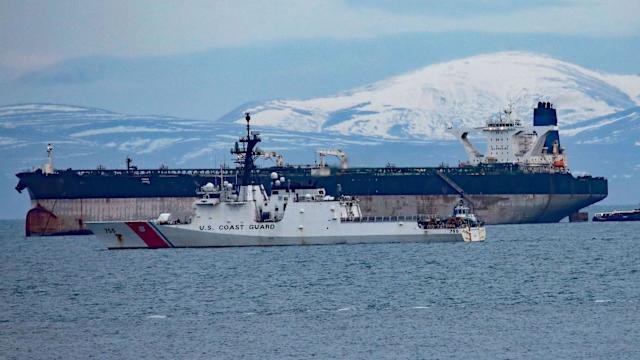
The tanker, formerly known as Bella 1, was last observed near Burghead over the weekend. Washington has accused the vessel of violating international sanctions by transporting oil linked to Venezuela, Russia, and Iran — allegations that form the basis of the U.S. seizure.
The UK government has publicly backed the operation, calling it a lawful enforcement action against sanctions breaches. The Ministry of Defence confirmed it provided operational support, while U.S. aircraft used several UK airfields, including bases in Scotland. Royal Navy tanker RFA Tideforce and RAF surveillance aircraft were also involved, with officials stating that disrupting Russia’s so-called “shadow fleet” remains a strategic priority.
Moscow has strongly condemned the seizure. Russian officials demanded that the crew be treated properly and returned home swiftly. The Russian transport ministry said the tanker had been granted “temporary permission” to sail under the Russian flag and argued that no state has the right to use force against a properly registered foreign vessel.
Political tensions have also surfaced within the UK. Scotland’s First Minister John Swinney said he was “deeply concerned” to learn through media reports that the tanker was being held in the Moray Firth, adding that he would have expected advance notice. UK Scottish Secretary Douglas Alexander later said he had offered Swinney a meeting on the matter, which was not taken up.
The Moray Firth — a sheltered stretch of sea between the Highlands, Moray, and Aberdeenshire — remains the location where the Marinera has been anchored near Burghead, a coastal village now thrust into the center of a complex international standoff.
As court proceedings continue and diplomatic tensions simmer, the case underscores the growing reach of sanctions enforcement — and the legal and political friction that can follow when jurisdictions collide.
