
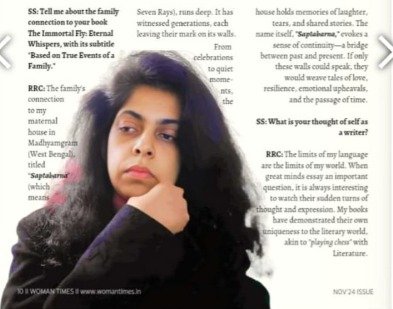

In a world that celebrates loud disruption and overnight success, Rituparna Ray Chaudhuri reminds us that some of the most powerful transformations happen in silence, one carefully chosen word at a time. A Kolkata-born educator, self-taught scholar, and author, she has earned international recognition not through institutional privilege or viral moments, but through rigorous intellectual discipline, profound personal resilience, and an unwavering faith in literature’s redemptive power. Frequently described as the university wit of the 21st century in the Oxbridge tradition—evoking the sharp intellect, elegant prose, and philosophical depth of the Elizabethan University Wits while channelling the analytical rigor associated with Oxford and Cambridge—Ray Chaudhuri offers a fresh, cross-cultural voice that bridges centuries and continents.
Ray Chaudhuri grew up steeped in literature and history. She studied at Gokhale Memorial Girls’ School and Presidency College, institutions that honed her incisive analytical mind. For her, teaching was never merely a profession; it was a living inheritance. She began as a private tutor in her maternal grandmother’s modest home in a Kolkata suburb named ‘Madhyamgram’: That same space has since blossomed into DS Academy, a testament to family legacy and quiet determination.
The name “DS” is rich with layered, almost poetic meaning. It honours her maternal grandmother, the Late Dipti Samaddar, a respected professional teacher affectionately known as “DS” throughout her career. At the same time, many observers note that “DS” also gestures toward the deep mother-daughter bond: Dipti Samaddar’s daughter was the Late Supti Roy Choudhury, Rituparna’s mother. In this interpretation, the “D” can signify “Daughter” in relation to Supti, creating a subtle, intergenerational tribute. Rituparna has reflected that it sometimes feels as if a greater hand—perhaps divine—deliberately wove these connections into the very fabric of the house. The family home in Madhyamgram itself was named Saptabarna (“Seven Rays” or “Seven Colors”) by her maternal grandmother, a name chosen to embrace the family and its generations. Today, that same address in Madhyamgram, Bireshpally North, pulses with new purpose as the physical and symbolic heart of DS Academy, where literature-rich, personalized education continues to flourish. Yet the path to this legacy was paved with devastating loss. On 7February 2019, her mother, Supti Roy Choudhury, passed away. Grief arrived like a tidal wave, intensified by financial hardship, betrayals, and profound isolation. Just months later, on July 8, 2019, Ray Chaudhuri channelled that sorrow into her poignant work *The Immortal Fly: Eternal Whispers—a memoir grounded in true family events, published by Partridge International (U.S.A.) in association with Penguin Random House (U.K.). The book transforms raw mourning into reflective meditation on memory, fate, and the enduring mother-daughter bond. Tragically, her father died on the very same date (July 8) in 2024, leaving her orphaned and forcing her to navigate renewed struggles while carefully “pinching every penny.” “Undeterred, she continued transforming the family home—Saptabarna—into a thriving academy amid emotional and economic tempests.”
Her scholarly contributions emerged hand in hand with this personal reckoning. In 2018, she published Realization, a collection of self-directed, philosophical analyses of selected works by William Shakespeare (Othello and Hamlet), John Keats (“Ode to a Nightingale”), and Rabindranath Tagore. Rather than offering conventional criticism, she probes deeper questions of language, emotion, identity, and human limitation. Subsequent books include The Revolt in the Desert: Journey on English Literature from India to the USA, which traces cross-cultural literary dialogues including her personal reflection in a limited manner through her versatile vocabulary style based on Mary Shelley’s Frankenstein; Illusion Verses Reality, a poetry collection with accompanying analysis for ISC students; and titles such as also Shall Lady Macbeth be called as Fourth Witch?, stand as eloquent, understated testaments to that possibility. Her works have found shelves at Oxford Bookstore in Kolkata and visibility on platforms including World Cat Library, Goodreads, PhilPapers, and Academia.edu, alongside her presence as a Google Scholar and Semantic Scholar.
What sets Ray Chaudhuri apart is her seamless fusion of rigorous academic insight with lived emotional truth. Literary observers have called her an “innate creator” and even “Divine Vengeance,” phrases that capture the fierce clarity and emotional precision she brings to silence and suffering. She has received recognitions including Harvard World Records and London Book of World Records for her contributions to literature and authorship. At the core of her writing lies a recurring conviction: the limits of language are the limits of our perceived world, yet meticulously chosen words can expand those boundaries, turning private whispers into universal resonance. In the Oxbridge spirit of intellectual wit and elegance, she wields her pen with both scholarly depth and poetic grace—earning her place as a university wit for our time.
Poverty has never been an abstract idea for her. Financial strain, societal doubt, and the relentless weight of grief repeatedly tested her resolve. Instead of withdrawing, she drew on discipline, empathetic networking, and mentorship to build DS Academy. The initiative reflects a profound belief that education and literature are powerful acts of legacy-making—particularly for women facing loss and scarce resources. In conversations, she speaks of finding strength in her mother’s memory, her grandmother’s example, her pets’ quiet companionship, and an inner certainty that purpose can bloom even in the harshest emotional soil. The house—once simply “Dida’s House” (Maternal Grandmother’s House in Madhyamgram)—now vibrates with the intertwined spirits of DS and Saptabarna:, a living monument where grandmother’s vision, mother’s legacy, and daughter’s determination converge.
For an international audience, Ray Chaudhuri’s work delivers something essential: a vital bridge between the British literary canon and a distinctly Indian sensibility. She engages Shakespeare and Keats alongside Tagore not as distant icons but as participants in an on-going, living conversation about power, beauty, mortality, and resilience. In doing so, she demonstrates that voices from the Global South are not peripheral footnotes—they are central to grasping the complete human narrative. Her journey resonates with anyone who has confronted grief, economic struggle, or self-doubt: creativity is not a luxury for the comfortable. It can be a vital survival strategy, a quiet form of resistance, and a way to honour what has been lost.
Today, as she continues nurturing DS Academy in Madhyamgram and shaping new writing, Rituparna Ray Chaudhuri embodies a deep truth. True resilience is rarely loud or linear. It often appears as pages composed in solitude, students guided in a transformed family home, or scholarly citations gathered through patient, careful analysis. The intertwined names “DS” and “Saptabarna” tell their own quiet story—of a grandmother’s vision, a mother’s enduring influence, a daughter’s steadfast courage, and the seven rays of light that continue to illuminate the way forward.
Her life suggests that when existence strips away certainty, the disciplined pursuit of knowledge and expression can reconstruct something lasting—something that extends well beyond one individual’s circumstances. In an age obsessed with instant victories, her path prompts a powerful question: What if the most meaningful contributions arise not despite hardship, but precisely because of the depth and clarity it demands? Ray Chaudhuri’s books and her academy stand as eloquent, understated testaments to that possibility—proof that grief, when met with courage and craft, can be transmuted into a radiant, seven-coloured form of immortality.
