

In India’s evolving creative industry, a noticeable shift has taken place over the last decade. Writers who once devoted themselves to books and long-form literature are increasingly moving toward film writing, screenplay development, and television series creation. The demand for fast-paced visual storytelling, digital content, and episodic narratives has reshaped the writing landscape.
In this changing environment, long-form book writing has slowly become less common among emerging creators. Yet, at the same time, a deeper need for reflective, research-driven, and human-centered writing has also begun to grow—especially in understanding people, behavior, and communication.
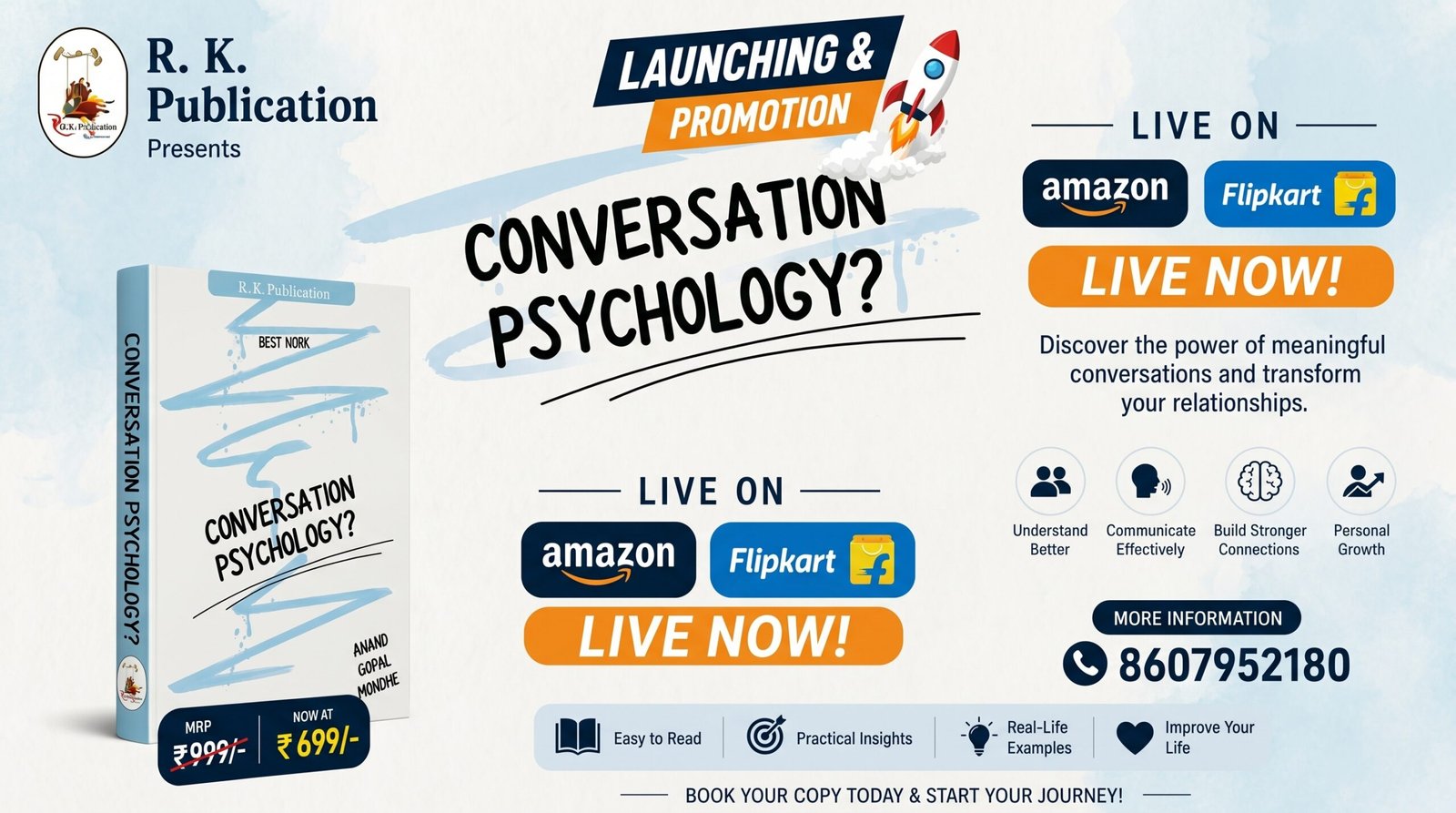
It is within this cultural and creative transition that the book “Conversation Psychology?” enters the discussion.
A Different Direction in a Visual Era
While most modern writers are adapting to screen-based storytelling, this work takes a different direction. Instead of focusing on external events or fictional drama, it focuses on something far more constant and universal—human conversation.
The central idea is simple but significant: conversations are not just exchanges of words. They are reflections of psychology, emotion, memory, and intent.
In a time when communication has become faster but often less meaningful, the book positions conversation as a subject worth serious observation and analysis.
Understanding Conversation as Human Behavior
“Conversation Psychology?” explores how everyday dialogue influences relationships, decisions, and emotional perception. It treats speech not just as language, but as behavior.
When people speak, they are not only sharing information. They are revealing confidence levels, emotional states, internal conflicts, and social positioning. Even silence within a conversation becomes meaningful.
The book approaches these patterns in a structured way—examining how tone, timing, word choice, and pauses affect understanding between individuals.
Why This Subject Matters Today
In today’s digital environment, communication is constant. Messages, comments, calls, and conversations happen across multiple platforms every second. But despite this increase in communication, misunderstandings have also increased.
The book raises an important observation: more conversation does not always mean better connection.
Many relationships—personal, professional, and social—face challenges not because of lack of communication, but because of misinterpreted communication. Words are spoken quickly, but processed emotionally in different ways by different people.
This gap between speaking and understanding is where “Conversation Psychology?” positions its focus.
A Human-Centered Perspective on Dialogue
Rather than treating conversation as a technical skill, the book presents it as a human system influenced by emotion, memory, and experience.
A simple sentence can carry multiple meanings depending on context. A short reply can feel distant or protective. A delayed response can create assumptions. These are not just linguistic outcomes—they are psychological reactions.
The book encourages readers to observe conversations more carefully, not just participate in them.
Relevance in Modern Writing Culture
In the current creative ecosystem, where screenwriting and digital content dominate, a work like this brings attention back to foundational human interaction.
It does not rely on fictional worlds or cinematic structures. Instead, it focuses on real-life patterns that exist in every household, workplace, friendship, and relationship.
This makes the subject widely relatable, regardless of profession or background.
A Shift from Expression to Observation
One of the key ideas reflected in the book is the shift from simply expressing thoughts to understanding how expression is received.
Most communication problems arise not at the point of speaking, but at the point of interpretation. What is said and what is understood are often not the same.
By studying these gaps, the book attempts to create awareness about how deeply conversation shapes human experience.
Conclusion
“Conversation Psychology?” stands as an exploration of everyday human interaction in a time when communication is everywhere, yet understanding is often missing.
In a creative era dominated by visual storytelling and rapid content production, this work returns attention to something fundamental—the spoken word and the mind behind it.
It does not claim to redefine psychology or language, but it raises a simple and important question for readers everywhere:
If we speak every day, why do we still misunderstand each other so often?
And in that question, the book finds its purpose.
Instagram: @anand_gopal_mondhe
Book: “Conversation Psychology?”
Book link: https://amzn.in/d/00cXOZAM