

India set out to showcase its technological muscle this week by hosting one of the world’s largest artificial intelligence gatherings. The ambition was clear: position the country as a rising AI powerhouse ready to compete on the global stage.
But what unfolded on the ground told a far more complicated story.
From logistical breakdowns to last-minute cancellations and viral on-stage moments, the summit became a striking mix of promise and disorder — a real-time example of Chaos, confusion, and $200 billion ambitions: Inside what I witnessed at India’s AI summit.
A Grand Vision Meets Ground Reality
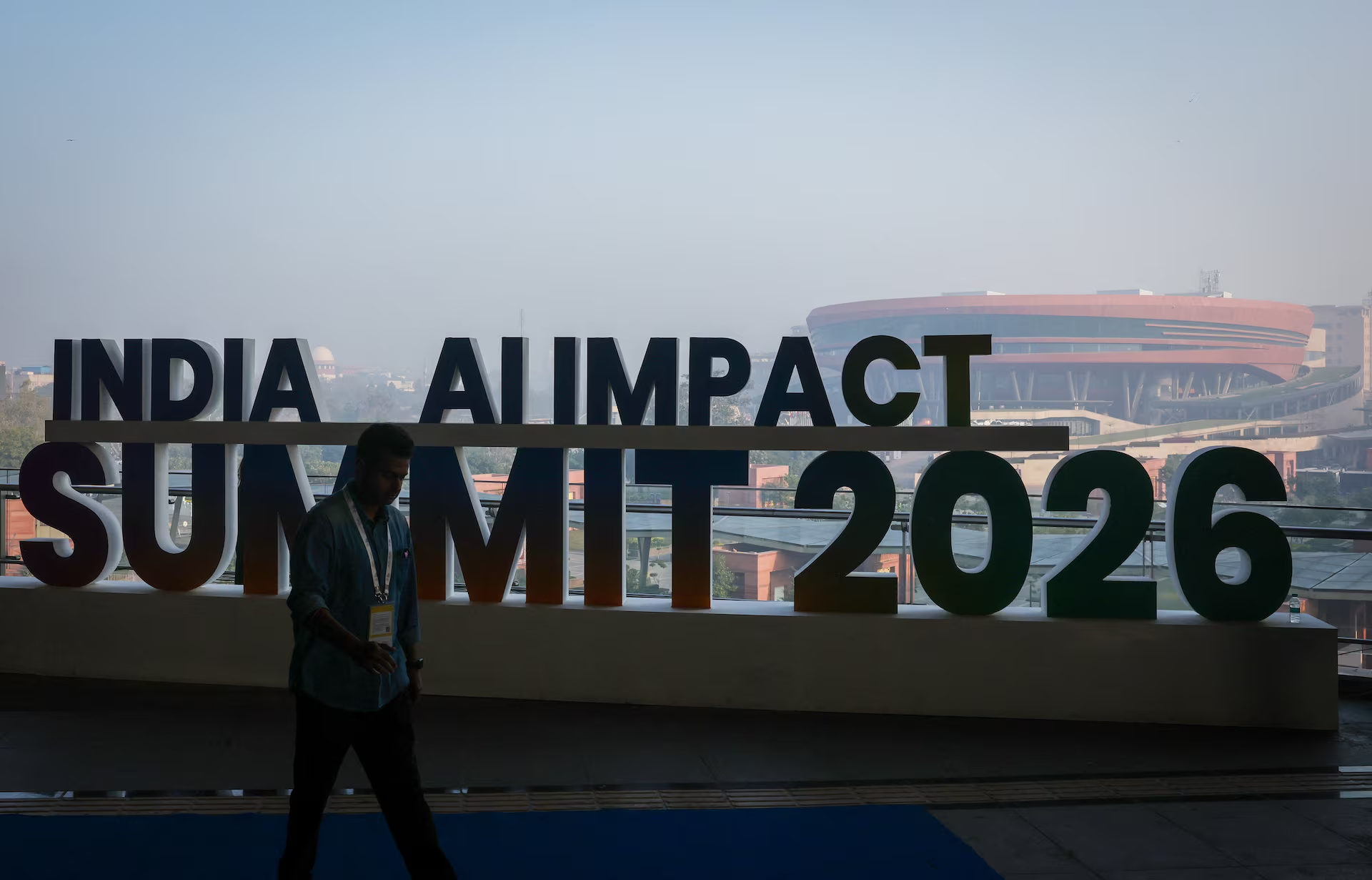
Held in New Delhi, the AI Impact Summit was meant to project India as the next global hub for artificial intelligence innovation. The government’s message was bold: India is open for AI business and ready to attract massive global investment.
Yet almost immediately, operational cracks began to show.
Having been on the ground since the start of the week, I can say without exaggeration that covering this event turned into one of the most demanding reporting experiences of my career.
Delhi traffic — notorious even on a good day — felt paralyzing. There were moments when vehicles didn’t move at all. On Wednesday alone, I had to attend events and interviews at three separate hotels. Coordinating travel between venues became an exercise in endurance and improvisation.
The real uncertainty, however, began at the summit’s main venue: Bharat Mandapam.
Security, Unclear Instructions, and Frustrated Delegates
When Prime Minister Narendra Modi was scheduled to inaugurate the summit, media access instructions were vague. At one point, we weren’t even sure if entry would be granted.
Eventually, we were told to arrive at 6 a.m. local time. When we did, security officials refused entry. A crowd of journalists gathered at the gates, all seeking clarity that never seemed to arrive. Inside, security personnel issued conflicting directions, adding to the confusion.
Several delegates quietly shared their frustrations with me. For an event designed to reflect India’s readiness to lead in AI, the organization often appeared strained.
India’s IT minister, Ashwini Vaishnaw, later apologized for the “problems” on the opening day — an acknowledgment that the execution had fallen short of expectations.
Controversies That Overshadowed the Stage
The summit wasn’t just challenged by logistics. It was punctuated by controversies that grabbed headlines.
One involved Bill Gates, who had been scheduled to deliver a keynote address. Early in the week, the Bill & Melinda Gates Foundation confirmed his participation. Then, suddenly, reports surfaced that he would no longer appear. The uncertainty fueled speculation and distracted from the event’s core focus.
Another episode centered on Galgotias University and a robotic dog demonstration. A professor told Indian state broadcaster Doordarshan that the robot had been “developed” by the university. Online observers quickly pointed out that the machine was manufactured by Chinese robotics company Unitree Robotics.
The university denied claiming it built the robot itself, clarifying that the project aimed to teach students AI programming using globally available tools. Still, the incident added to the sense of disorder.
Then there was the viral moment on stage.
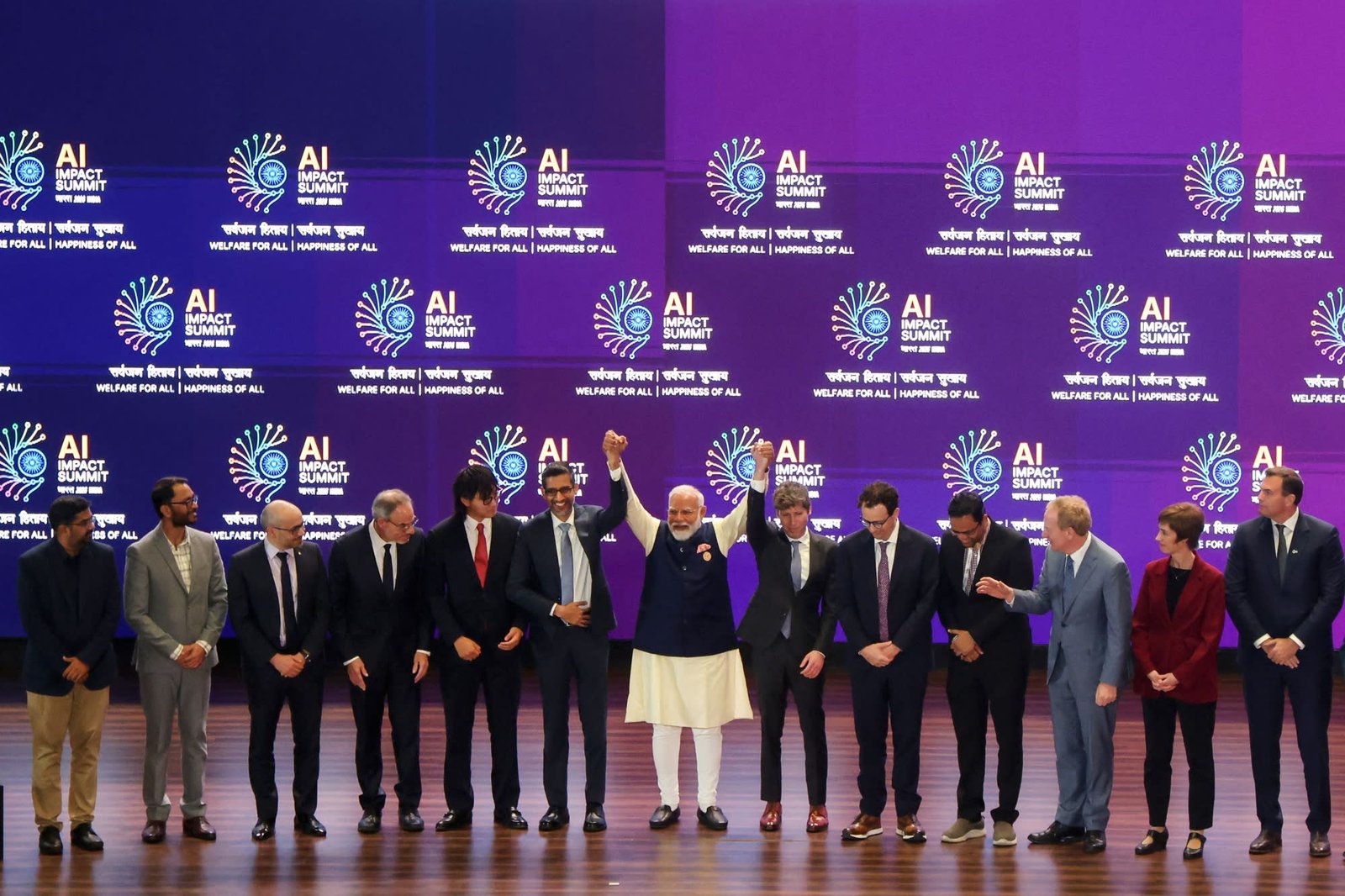
During a symbolic hand-holding segment led by Modi, two of the AI industry’s most influential leaders — Sam Altman and Dario Amodei — hesitated and did not immediately follow the cue. Social media lit up with commentary. Altman later explained that he was simply confused about what was happening.
The irony? Just days earlier, Anthropic had aired a Super Bowl ad subtly criticizing OpenAI’s move to test ads inside ChatGPT. The tension, whether playful or competitive, added intrigue to the summit’s atmosphere.
Big Tech’s India Bet
Despite the setbacks, something undeniable was happening beneath the surface.
Global tech leaders showed up — and not quietly.
From Sundar Pichai of Alphabet Inc. to Sam Altman, executives repeatedly emphasized India’s strengths: a vast developer base, a rapidly digitizing economy, and one of the world’s largest consumer markets.
“The excitement here has been incredible to watch,” Altman told me during the summit.
Announcements followed.
OpenAI revealed it would become the first customer of Tata Consultancy Services’ data center business. Google unveiled partnerships with researchers and academic institutions to expand its Gemini AI ecosystem in India.
Every CEO I spoke with echoed a similar message: India matters — not just as a market, but as a talent engine.
The $200 Billion Dream
Behind the scenes of long traffic jams and organizational confusion stood a far bigger narrative.
The Indian government used the summit to declare an ambitious goal: attracting $200 billion in AI investment over the next two years.
That staggering figure reflects how seriously policymakers view artificial intelligence as a driver of economic transformation. From infrastructure development to semiconductor manufacturing and AI research, the country is positioning itself as a central node in the global tech supply chain.
And here lies the paradox captured in Chaos, confusion, and $200 billion ambitions: Inside what I witnessed at India’s AI summit.
On one hand, the event exposed operational weaknesses and public relations missteps. On the other, it demonstrated India’s undeniable gravitational pull for global technology companies.
Even amid honking cars, unclear instructions, and viral social media moments, the enthusiasm from Big Tech never faded.
Beyond the Noise
If anything, the summit revealed two truths about India’s AI journey.
First, ambition is not in short supply. The vision is expansive, bold, and unapologetically global.
Second, execution must catch up with aspiration.
India’s AI story is still being written. This summit may have stumbled in presentation, but it succeeded in drawing the world’s most powerful technology leaders to one stage in New Delhi.
And perhaps that is the clearest signal of all: despite the chaos and confusion, the world is betting that India’s AI ambitions are real — and potentially transformative.
